
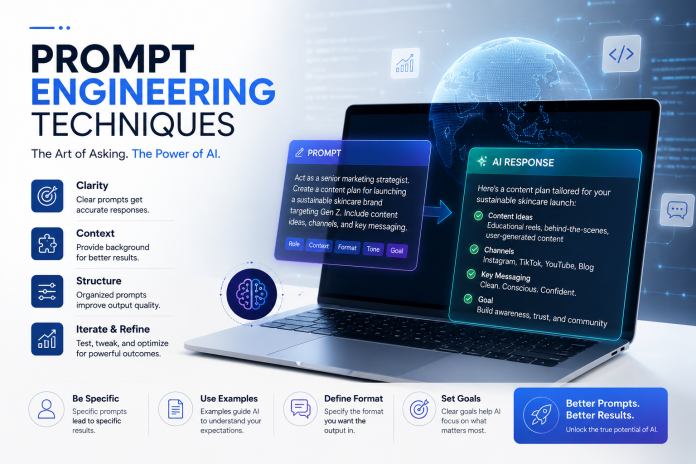
Once you’ve mastered the basics of prompt writing – being clear, specific, and providing context. There are more advanced techniques that can further improve the quality and accuracy of AI-generated responses. These techniques are particularly useful for complex tasks, technical problems, or situations requiring nuanced, well-reasoned outputs.
This guide explores seven advanced prompt engineering techniques to help you get even better results from AI language models like ChatGPT and Claude.
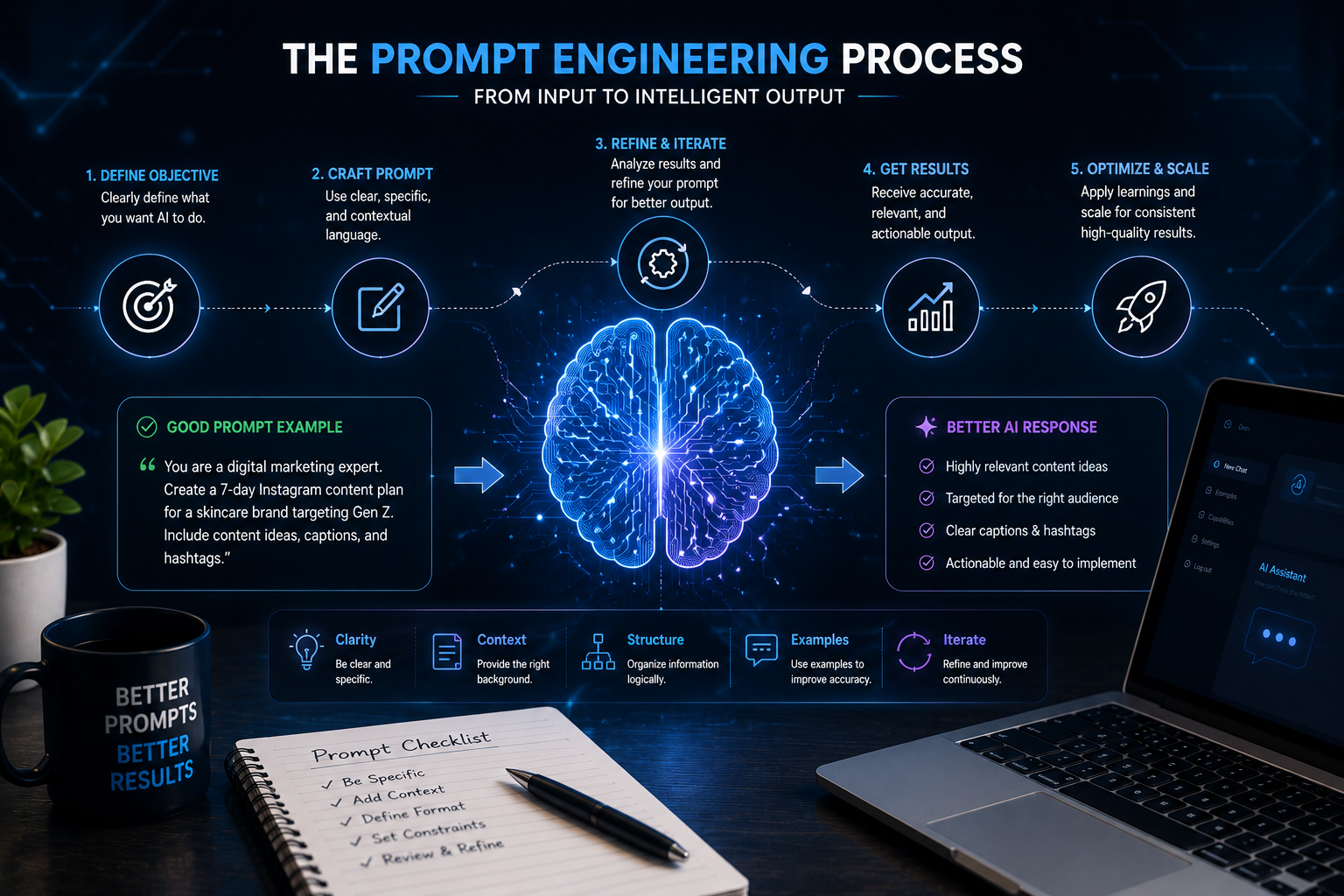
1. Chain-of-Thought Prompting
Chain-of-thought prompting involves asking the AI to work through a problem step-by-step, explicitly reasoning through each stage before arriving at a final answer. This technique often significantly improves accuracy for complex reasoning, math problems, or multi-step logical tasks.
Example: “Solve this problem step by step, showing your reasoning at each stage: If a store offers a 20% discount on a $150 item, and then applies an additional 10% loyalty discount on the discounted price, what is the final price?”
By explicitly requesting step-by-step reasoning, you often get more accurate results compared to asking for a direct answer, as the model is encouraged to work through the logic methodically rather than jumping to a potentially incorrect conclusion.
2. Few-Shot Learning with Examples
Few-shot prompting involves providing the AI with a small number of examples demonstrating your desired input-output pattern before asking it to complete a similar task. This technique is particularly effective for tasks requiring a specific format, style, or structure.
Example: “Here are two examples of how we write customer testimonials for our website: Example 1: [testimonial example] Example 2: [testimonial example] Now, write a similar testimonial based on this customer feedback: [raw feedback]”
Providing concrete examples helps the AI understand subtle stylistic or structural preferences that might be difficult to explain through direct instructions alone.
3. Role-Based and Persona Prompting
Assigning a specific role or persona to the AI can help shape the tone, expertise level, and perspective of its responses, often producing more targeted and relevant outputs.
Example: “As an experienced UX designer with 10 years of experience, critique this website’s navigation structure and suggest three specific improvements.”
This technique works particularly well for tasks requiring domain-specific expertise or a particular professional perspective, helping the AI frame its response appropriately.
4. Structured Output Formatting
Explicitly specifying the exact structure you want for the AI’s response can significantly improve usability, particularly for tasks where the output will be used in a specific format or system.
Example: “Provide your response in the following format:
- Problem Summary: [brief description]
- Root Cause: [analysis]
- Recommended Solution: [specific action steps]
- Expected Outcome: [predicted results]”
This technique is particularly valuable for business applications where consistent, structured outputs are needed for reports, documentation, or integration with other systems.
5. Constraint-Based Prompting
Adding specific constraints to your prompts can help focus the AI’s response and avoid common pitfalls like overly long or unfocused answers.
Example: “Explain the concept of compound interest in exactly 100 words, using a simple analogy that a teenager would understand, without using any technical jargon.”
By specifying constraints like word count, target audience, and stylistic requirements, you can more precisely control the nature of the response you receive.
6. Self-Critique and Refinement Prompting
This technique involves asking the AI to review and critique its own initial response, then provide an improved version based on that self-assessment.
Example: “Write a first draft of a product description for [product]. Then, critique your own draft for clarity, persuasiveness, and accuracy, and provide an improved final version based on that critique.”
This approach can help surface and correct weaknesses in initial responses, often resulting in higher-quality final outputs.
7. Multi-Perspective Prompting
For complex or controversial topics, asking the AI to consider multiple perspectives or approaches can produce more balanced, comprehensive responses.
Example: “Analyze the pros and cons of remote work policies from three different perspectives: the employee, the employer, and the broader economy.”
This technique is particularly valuable for decision-making support, strategic planning, or situations where understanding multiple viewpoints adds genuine value.
Combining Advanced Techniques
These advanced techniques can often be combined for even more sophisticated prompting strategies. For example, you might combine chain-of-thought prompting with role-based prompting and structured output formatting for a complex business analysis task:
Example combined prompt: “As an experienced business consultant, analyze this company’s quarterly performance data step by step, considering revenue trends, cost structures, and market conditions. Provide your analysis in the following format: Key Findings, Root Causes, Recommendations, and Expected Impact.”
When to Use Advanced Prompting Techniques
Advanced prompt engineering techniques are particularly valuable for:
- Complex reasoning or analytical tasks where step-by-step thinking improves accuracy
- Tasks requiring specific formatting or structure for downstream use
- Situations requiring domain-specific expertise or perspective
- High-stakes outputs where quality and accuracy are particularly important
- Recurring tasks where establishing consistent patterns saves time over repeated use
For simpler, everyday tasks, basic prompting principles are often sufficient, and advanced techniques may add unnecessary complexity without meaningful benefit.
Practical Tips for Applying Advanced Techniques
- Start simple and add complexity gradually begin with basic prompts and incorporate advanced techniques only when needed to improve results.
- Test and compare different approaches for important or recurring tasks to identify which techniques work best for your specific needs.
- Document effective prompt patterns you develop, building a personal library of successful approaches for future use.
- Stay updated on emerging techniques, as prompt engineering best practices continue to evolve alongside AI model improvements.
Final Thoughts
Advanced prompt engineering techniques like chain-of-thought reasoning, few-shot learning, and role-based prompting can significantly improve the quality and accuracy of AI-generated responses, particularly for complex or high-stakes tasks. By understanding when and how to apply these techniques, you can consistently achieve better results from AI language models across a wide range of professional and personal applications.
As AI capabilities continue to evolve, developing sophisticated prompting skills will remain a valuable asset for maximizing the value these powerful tools can provide.
Frequently Asked Questions
- What is chain-of-thought prompting used for?
Chain-of-thought prompting is particularly useful for complex reasoning, math problems, or multi-step logical tasks, as it encourages the AI to work through problems methodically rather than jumping to potentially incorrect conclusions. - When should I use few-shot prompting instead of zero-shot prompting?
Few-shot prompting is particularly useful when you need a specific format, style, or structure that would be difficult to explain through direct instructions alone, while zero-shot prompting works well for more straightforward, general tasks. - Do advanced prompting techniques work with all AI models?
Most advanced techniques apply broadly across major AI language models, though effectiveness may vary somewhat depending on the specific model and its particular capabilities. - Is it worth learning advanced prompt engineering for everyday tasks?
For simple, everyday tasks, basic prompting principles are often sufficient. Advanced techniques become more valuable for complex, high-stakes, or recurring tasks where improved accuracy or consistency provides meaningful benefit. - How do I know which advanced technique to use for a specific task?
Consider the nature of your task — use chain-of-thought for complex reasoning, few-shot for specific formatting needs, role-based prompting for domain expertise, and structured formatting when consistent output structure matters for your use case.