
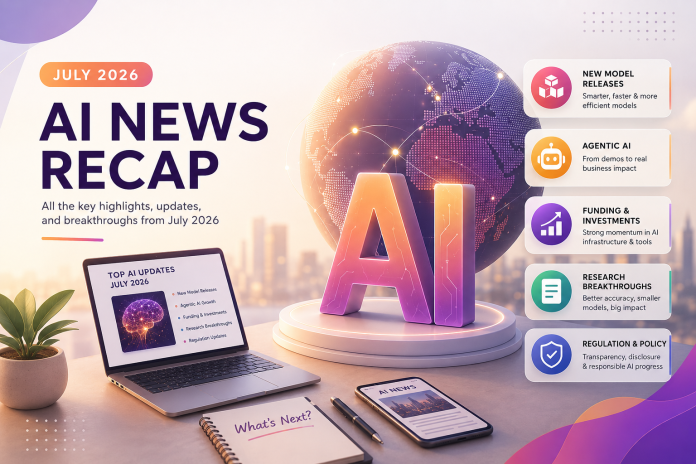
July 2026 turned out to be one of the busiest months in AI so far this year. Between new model releases, fresh funding rounds, and several research papers that genuinely advanced the field, there was a lot to keep track of. If you spent the month focused on work and missed the headlines, this recap brings together the most important developments in simple, easy-to-understand language.
Whether you’re a founder deciding which AI tools to adopt, a developer exploring new capabilities, or simply someone who wants to stay updated without reading dozens of newsletters, this article will help you catch up in just a few minutes.
The Biggest AI Model Releases in July 2026
The month began with several leading AI companies releasing upgraded models, each focused on improving reasoning capabilities while reducing the cost per query. Instead of simply making models larger, most labs concentrated on training efficiency and introducing specialized reasoning modes that allow models to “think longer” only when complex tasks require it.
For businesses and everyday users, this translates into lower API costs, faster response times for common tasks, and more advanced reasoning when solving coding challenges, research, or multi-step planning. If your organization relies on AI-powered applications, July was an excellent time to reassess your preferred model because the price-to-performance ratio improved significantly.
Agentic AI Continued Moving Into Real-World Use
One of the biggest themes throughout July was the continued rise of agentic AI. Rather than remaining limited to impressive demonstrations, AI agents increasingly found their way into production environments where they could independently complete multi-step tasks.
Modern AI agents are now capable of researching information across multiple sources, completing forms, managing customer support requests, scheduling tasks, and automating repetitive business processes with minimal human intervention.
For businesses handling repetitive workflows such as lead qualification, data entry, document processing, or customer support, July demonstrated that agent-based automation is becoming a practical alternative to traditional chatbots.
Funding and Major Industry Developments
Investment in AI startups remained strong throughout July, particularly for companies building AI infrastructure rather than consumer-facing applications. Investors showed significant interest in evaluation platforms, AI orchestration tools, monitoring systems, and specialized data infrastructure.
This trend is important because strong funding in infrastructure typically leads to better developer tools, lower costs, and more reliable AI platforms becoming available to businesses of all sizes over the coming months.
Important AI Research Papers
Several research papers published during July focused on solving practical problems instead of purely academic challenges.
Reducing AI Hallucinations
Researchers continued making progress in lowering hallucination rates, particularly for retrieval-based systems that combine AI models with external knowledge sources.
Smaller Models Becoming More Powerful
Another important trend involved techniques that allow smaller AI models to achieve performance much closer to significantly larger models for specialized tasks.
For companies building AI-powered products, this is especially valuable because fine-tuning smaller, more affordable models is becoming a realistic alternative to relying on expensive large-scale models for every use case.
AI Regulation and Policy Updates
Governments and regulatory bodies continued discussing AI governance throughout July, with particular attention on transparency requirements for AI-generated content and the use of copyrighted or personal data during model training.
Although no major legislation came into effect during the month, the overall direction remains clear. Businesses should expect stronger disclosure requirements for AI-generated content and increased scrutiny regarding training data over the next year.
If your company publishes AI-assisted content or uses AI to support customer-facing decisions, keeping track of these regulatory developments will help avoid compliance challenges in the future.
What July Means for August 2026
The trends established during July are likely to continue in the coming months. AI companies will probably keep competing on efficiency and affordability rather than simply increasing model size.
Agentic AI will continue expanding into business operations, especially across customer support, workflow automation, and operational management. Meanwhile, regulatory discussions are expected to progress gradually without dramatic short-term changes.
For individuals and businesses using AI regularly, one of the best practices is reviewing your AI tools every month or two. The AI landscape evolves so quickly that the best solution from a few months ago may no longer provide the best value today.
Frequently Asked Questions
1. What was the biggest AI development in July 2026?
The most significant trend was the industry’s shift toward more efficient reasoning models that balance performance, speed, and cost, alongside the rapid adoption of agentic AI in real business environments.
2. Is agentic AI ready for business use?
Yes, especially for repetitive, well-defined workflows such as research, lead qualification, document processing, and customer support. Most businesses should begin with lower-risk automation before expanding into more complex tasks.
3. Will AI regulation affect small businesses?
Yes, although gradually. Most current proposals focus on transparency and disclosure requirements for AI-generated content, making it important for businesses using AI in marketing or customer communications to stay informed.
4. Where can I find next month’s AI news recap?
This article is part of an ongoing monthly AI news series. Check back for the August 2026 edition covering the latest AI developments, product launches, research breakthroughs, and industry updates.
Read this also : Biggest AI News and Breakthroughs of 2026 (So Far)