
A new kind of AI model is trending today (Nov 12, 2026): one that never writes a sentence and only returns probabilities.
A viral card says Google just launched “Gemini Decision 1.” We could not find a Google product by that name. The model with that name belongs to Microsoft.
What Happened
First, the correction. The viral summary mixes several separate stories:
- Microsoft, not Google: Microsoft-Decision-1 was released on Oct 9, 2026, according to a progressiverobot write-up. It returns a calibrated probability for each answer in a single pass. Satya Nadella introduced it as a new model for fast decision-making.
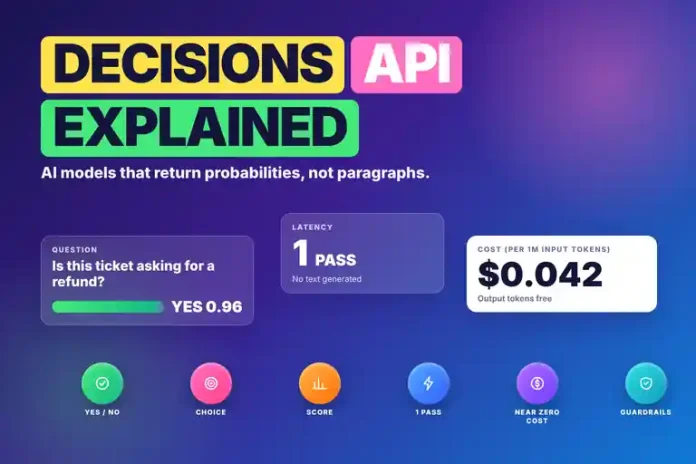
- Price: Microsoft prices it at $0.042 per million input tokens, with output tokens free. That is likely where the “$0 for output” line came from.
- Base model: Microsoft post-trained Alibaba’s open-weight Qwen3.5-9B for single-pass scoring, and says it will rebase it on other models later.
- OpenAI: made its Decisions API generally available on Oct 22, adding prompt caching, JSON input, a GPT-Live integration and a limit of 400 questions per request (Parallel).
- TypeSafe: its Jev model popularized the request shape most vendors now copy. TypeSafe claims 70 to 500 ms end to end, and released Jev 1.14 on Oct 14.
- Google and DNA: Google DeepMind’s AlphaGenome Atlas was released on Sept 8, 2026, not today. It holds predictions for about 9 billion possible single-letter DNA changes and is free for non-commercial research. We found no “AlphaGenome 2.”
Why It Matters
For Users
You will never chat with a decision model. It sits behind the app and makes quick calls: Is this email spam? Does this ticket ask for a refund? Is this photo damaged?
For you, that means faster and cheaper features. It also means fewer long AI answers for simple yes/no tasks.
For Businesses and Developers
A Decisions API takes your input and a set of questions with fixed answers, then returns a probability for each answer. It writes no text (Parallel).
Common question types look like this:
| Type | OpenAI name | TypeSafe name | What it returns |
|---|---|---|---|
| Yes or no | predicate | noul | Probability from 0 to 1 that the condition is true |
| Multiple choice | choice | choice | Probability for each option |
| Rating | score | score | A calibrated score |
Why teams like it:
- Speed. One forward pass instead of generating token after token.
- Low cost. Microsoft’s published list price is $0.042 per million input tokens with free output. OpenAI’s price was not confirmed in the material we reviewed.
- Structured output. You get numbers you can plug into code, such as routing, guardrails and moderation.
- Many questions at once. You can ask several questions about one text in a single call. Questions that depend on an earlier answer need a second request.
The limit is clear. A decision model is more constrained than a chat model. It is best for classification and checks, not open-ended work.
For The AI Industry
Decision models are becoming a new product category. Microsoft calls them an important new category in AI, and four vendors had hosted options with published pricing by Oct 25, according to Parallel.
Expect price pressure. When output tokens are free and input costs cents per million, the cheap, boring tasks in every AI workflow become almost free. That helps small teams and hurts anyone who charges a premium for simple classification.
Social Reaction
We found very little verified social discussion tied to this exact topic, so this section summarizes analyst and developer commentary rather than quoting posts.
Supporters say
- Single-pass scoring is a practical fix for slow, expensive agent guardrails.
- A shared request shape across vendors makes switching easier.
- Calibrated probabilities are more useful than a confident-sounding paragraph.
Critics say
- Many benchmark numbers are vendor-measured. One open model’s author noted that comparisons were measured by the author and not endorsed by TypeSafe.
- Reports noted that Microsoft quietly edited its Decision-1 speed claim, so check the latest wording.
- Probabilities can look precise even when the question is vague.
What To Do Next
- List your yes/no tasks. Spam checks, intent routing and policy checks are the best first candidates.
- Run a small test. Compare a decision model against your current LLM on 200 real questions, and measure accuracy and cost.
- Ignore wrong labels. If a post says “Google Decision 1,” check the vendor’s own page first. Get more explainers at aitrendssetter.com.
FAQ
What is a Decisions API?
It is an endpoint that takes your input and questions with fixed answer options, then returns a probability for each option. It writes no text.
Did Google launch Gemini Decision 1?
We could not find any such Google product. Decision-1 is a Microsoft model released on Oct 9, 2026.
How much does Microsoft Decision-1 cost?
$0.042 per million input tokens, with output tokens free, according to reporting on the launch.
What is AlphaGenome Atlas?
It is a Google DeepMind database of precomputed predictions for about 9 billion possible single-letter DNA changes, released Sept 8, 2026. It is free for non-commercial research and is not validated for clinical use.
Conclusion
Decision models are cheap, fast and quietly useful, but the viral story got the company wrong. Check the source before you share, and test on your own data before you switch.
Source: Based on reports from Parallel, progressiverobot, Techstrong, Sovereign Magazine and Google DeepMind’s published documentation as of Nov 12, 2026