
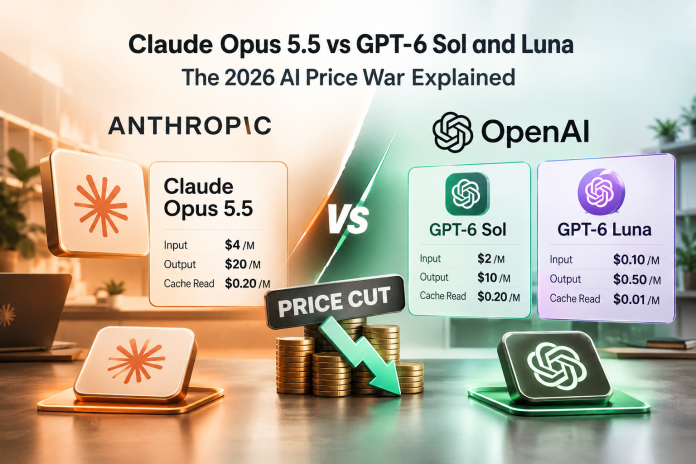
On September 22, 2026, two of the biggest names in AI shipped major model updates within about ninety minutes of each other, and both moves were framed around one thing: cost. Anthropic released Claude Opus 5.5, and shortly after, OpenAI answered with GPT-6 Sol and GPT-6 Luna. Together, the launches reset how much it costs to run frontier-grade AI, and they give businesses a very different pricing map to plan around for the rest of 2026.
What Happened on September 22, 2026
Anthropic went first with Claude Opus 5.5, the first model in its new 5.5 family. The company said it performs at the level of its previous flagship, Claude Fable 5.1, on most tasks while cutting the cost of running it by around 40 percent compared to Opus 5. Roughly ninety minutes later, OpenAI launched GPT-6 Sol and GPT-6 Luna, two mid-tier and budget models that sit below its flagship GPT-6 Astra. Both companies cut prices by roughly half compared to their prior generation’s promotional rates.
Claude Opus 5.5: Pricing and What It Offers
- Input tokens: $4 per million (down from $5 for Opus 5)
- Output tokens: $20 per million (down from $25 for Opus 5)
- Cache reads: $0.20 per million, a 60 percent cut from Opus 5
- Roughly 30 percent faster output generation than Opus 5
- Available immediately across all Anthropic platforms
Anthropic’s pitch is that Opus 5.5 is the efficient version of a frontier-class model, not a new capability ceiling, but the same tier of reasoning at a meaningfully lower bill, especially for coding and agentic workloads that lean heavily on cached context.
GPT-6 Sol and GPT-6 Luna: Pricing and What They Offer
OpenAI’s answer came in two tiers:
- GPT-6 Sol: $2 per million input tokens, $10 per million output tokens in the half of Opus 5.5’s rate
- GPT-6 Luna: $0.10 per million input tokens, $0.50 per million output tokens roughly 40 times cheaper than Opus 5.5
- Both models carry roughly 1.05 million-token context windows and support function calling, web search, file search and computer use
- Cached input reads get a 90 percent discount on both models
Sol is positioned as the everyday workhorse for coding and agent tasks on a tighter budget, while Luna is built for high-volume, simpler jobs where raw throughput matters more than peak reasoning.
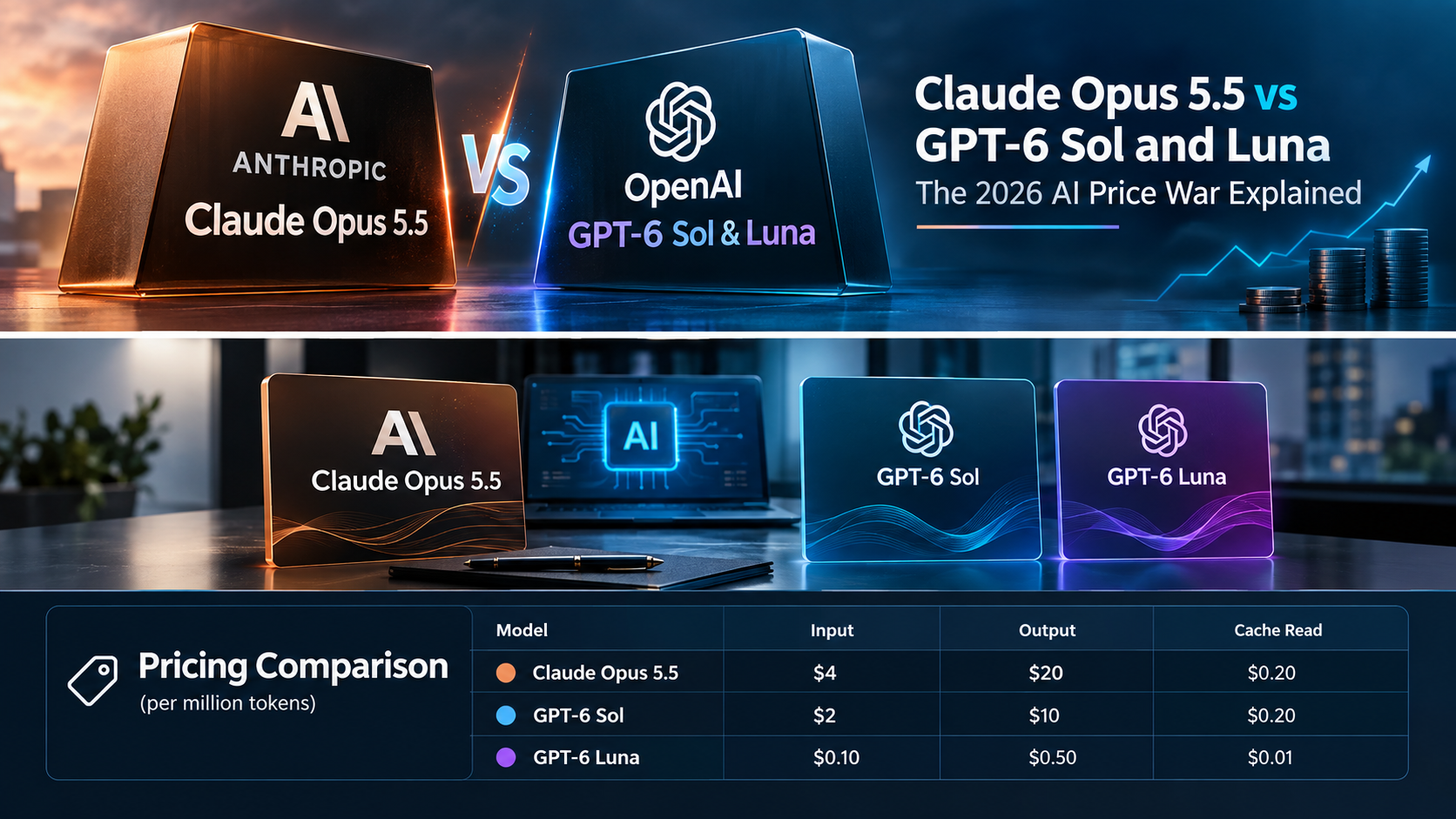
Side-by-Side Pricing (per million tokens)
| Model | Input | Output | Cache Read |
|---|---|---|---|
| Claude Opus 5.5 | $4 | $20 | $0.20 |
| GPT-6 Sol | $2 | $10 | $0.20 |
| GPT-6 Luna | $0.10 | $0.50 | $0.01 |
Benchmark Snapshot: Who Wins Where
Early third-party testing paints a mixed picture rather than a clean winner. On OpenAI’s own AutomationBench figures, GPT-6 Sol at its highest effort setting scored 33.2 percent, ahead of Claude Opus 5 (not 5.5) at its own maximum setting. Independent evaluation from Artificial Analysis ranked Opus 5.5 Max first on its Intelligence Index, while a separate ten-task practitioner comparison preferred Opus on seven of ten tasks despite a higher total cost. In short: Opus 5.5 tends to lead on demanding reasoning and coding work, while Sol and Luna win decisively on cost-per-task for everyday and high-volume jobs.
Which Model Should You Actually Use
Demanding coding and knowledge work
Start with Claude Opus 5.5. It remains the stronger choice when task quality matters more than shaving a few cents off each run, particularly for complex coding, research and long-context agentic work.
Everyday coding and agents on a budget
Test GPT-6 Sol first. At half of Opus 5.5’s per-token rate, it’s a strong fit for teams that need solid agentic performance without frontier pricing.
High-volume, simple tasks
Try GPT-6 Luna. For classification, extraction, and other high-throughput jobs that don’t need deep reasoning, its price makes it the default choice.
What This Price War Means Going Forward
This is the second time in 2026 that aggressive pricing from one lab has forced a rapid response from another, and it points to where the market is heading: frontier-adjacent performance at commodity prices. For businesses building AI-powered tools or automations, this is good news – the cost of running production-grade AI keeps dropping faster than the underlying capability plateaus, according to coverage from outlets tracking the launch. Expect more labs to follow this same playbook of shipping a flagship, then quickly following with a cheaper, near-equivalent tier.
Frequently Asked Questions
1. Is GPT-6 Sol cheaper than Claude Opus 5.5?
Yes. GPT-6 Sol costs $2 per million input tokens and $10 per million output tokens, exactly half of Claude Opus 5.5’s $4/$20 rate.
2. What is the cheapest of the three models?
GPT-6 Luna, at $0.10 per million input tokens and $0.50 per million output tokens, is the cheapest by a wide margin.
3. Which model performs best on coding tasks?
Independent testing generally favors Claude Opus 5.5 for demanding coding and reasoning work, while GPT-6 Sol and Luna offer a better cost-per-task ratio for lighter workloads.