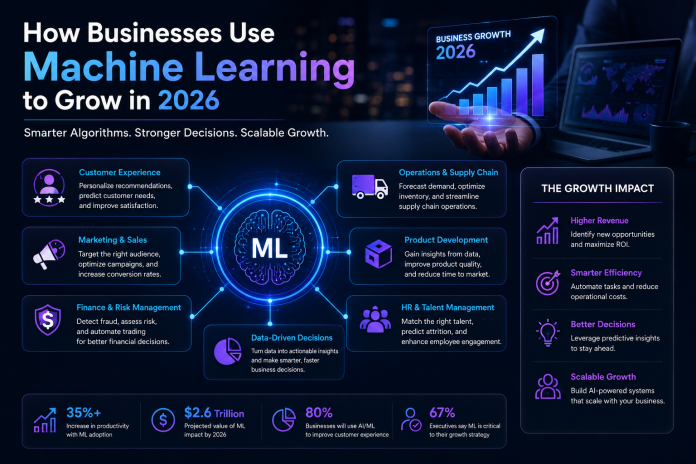
Machine Learning has moved well beyond research labs and tech giants today, businesses of nearly every size and industry are leveraging ML to improve efficiency, personalize customer experiences, and make smarter decisions. What was once considered a cutting-edge, expensive technology is now accessible through cloud-based platforms and user-friendly tools.
This article explores how businesses are practically applying Machine Learning today, the benefits they’re seeing, and how organizations can get started with ML adoption.

Why Businesses Are Investing in Machine Learning
The rise in Machine Learning adoption isn’t just a technology trend. it’s driven by tangible business value. Companies investing in ML are seeing measurable improvements in several key areas:
- Increased operational efficiency through automation of repetitive tasks
- Better decision-making based on data-driven insights rather than guesswork
- Enhanced customer experiences through personalization at scale
- Competitive advantage by identifying trends and opportunities faster than competitors
As ML tools become more accessible and affordable, adoption is no longer limited to large enterprises with dedicated data science teams.
Key Business Applications of Machine Learning
1. Customer Personalization
One of the most impactful uses of Machine Learning in business is personalization. E-commerce platforms, streaming services, and content providers use ML algorithms to analyze user behavior and deliver tailored recommendations.
Example: Online retailers use ML to recommend products based on browsing history, past purchases, and similar customer behavior patterns, significantly increasing conversion rates.
2. Predictive Analytics
Machine Learning enables businesses to forecast future trends based on historical data, helping with everything from inventory management to financial planning.
Example: Retail businesses use predictive analytics to forecast seasonal demand, ensuring optimal inventory levels and reducing both stockouts and excess inventory.
3. Customer Service Automation
AI-powered chatbots and virtual assistants, built on Machine Learning models, handle routine customer inquiries, freeing up human agents for more complex issues.
Example: Companies use ML-powered chatbots to handle FAQs, process simple requests, and route complex issues to appropriate human representatives, improving response times and customer satisfaction.
4. Fraud Detection and Risk Management
Financial institutions and e-commerce businesses use Machine Learning to detect fraudulent transactions in real time by analyzing patterns and flagging anomalies.
Example: Payment processors use ML models to identify unusual transaction patterns, significantly reducing fraud-related losses compared to traditional rule-based systems.
5. Marketing Optimization
Machine Learning helps businesses optimize marketing campaigns by analyzing customer data to identify the most effective messaging, timing, and channels.
Example: Digital marketing platforms use ML to automatically adjust ad bidding strategies in real time, maximizing return on ad spend based on performance data.
6. Human Resources and Recruitment
HR departments use Machine Learning to streamline recruitment processes, from resume screening to identifying candidates most likely to succeed in specific roles.
Example: Companies use ML-powered applicant tracking systems to filter large volumes of resumes, highlighting candidates who best match job requirements.
7. Supply Chain Optimization
Machine Learning helps businesses optimize supply chain operations by predicting demand, identifying potential disruptions, and improving logistics efficiency.
Example: Manufacturing companies use ML models to predict equipment maintenance needs, reducing costly downtime through proactive repairs.
Benefits of Machine Learning for Small and Medium-Sized Businesses
While large enterprises have historically led ML adoption, small and medium-sized businesses (SMBs) are increasingly benefiting from accessible, cloud-based ML tools. Key advantages include:
- Lower barrier to entry: Cloud platforms offer pre-built ML models that don’t require extensive technical expertise
- Scalable solutions: Businesses can start small and expand ML usage as needs grow
- Cost-effective personalization: Even small businesses can deliver personalized customer experiences using affordable ML-powered tools
- Competitive parity: ML adoption helps SMBs compete more effectively with larger organizations that have historically had greater data resources
Challenges Businesses Face When Adopting Machine Learning
Despite its benefits, businesses often encounter challenges when implementing Machine Learning:
- Data quality issues: ML models require clean, relevant data to produce accurate results
- Lack of technical expertise: Many businesses lack in-house data science talent
- Integration complexity: Incorporating ML into existing business systems can require significant technical effort
- Unclear ROI expectations: Businesses sometimes struggle to measure the direct impact of ML investments
Addressing these challenges typically involves starting with clearly defined use cases, ensuring data quality, and considering third-party ML platforms that reduce technical barriers to entry.
How to Get Started with Machine Learning in Your Business
For businesses looking to adopt Machine Learning, consider these practical steps:
- Identify a specific business problem where data-driven insights could provide clear value, such as customer churn prediction or inventory optimization.
- Assess your existing data to determine whether you have sufficient, quality data to support ML initiatives.
- Explore accessible ML platforms that offer pre-built models and don’t require extensive technical expertise.
- Start with a pilot project to test ML’s impact before committing to larger-scale implementation.
- Measure results and iterate based on performance data, refining your approach as you gain more experience.
The Future of Machine Learning in Business
As Machine Learning technology continues to mature, businesses can expect even greater accessibility and more sophisticated applications. Emerging trends include:
- No-code and low-code ML platforms, making ML adoption easier for non-technical teams
- Increased integration with generative AI, combining predictive ML models with content generation capabilities
- Greater focus on ethical AI practices, ensuring ML models are fair, transparent, and free from harmful bias
- Expansion into new industries, as ML tools become more specialized for niche business needs
Businesses that begin building ML literacy and experimenting with practical applications today will be better positioned to leverage more advanced capabilities as the technology continues to evolve.
Final Thoughts
Machine Learning has become a practical, accessible tool for businesses of all sizes, offering tangible benefits across customer personalization, predictive analytics, fraud detection, and operational efficiency. As adoption barriers continue to lower, more businesses will be able to leverage ML to drive growth and maintain a competitive edge.
For organizations still exploring Machine Learning, starting with a focused, well-defined use case is often the most effective path toward realizing measurable business value.
Frequently Asked Questions
- Do small businesses really benefit from Machine Learning?
Yes. Cloud-based ML platforms have made these tools accessible and affordable for businesses of all sizes, not just large enterprises with dedicated data teams. - What is the most common business use case for Machine Learning?
Customer personalization, such as product recommendations and targeted marketing, is one of the most widely adopted ML applications across industries. - How much data does a business need to use Machine Learning effectively?
The amount of data needed varies by use case, but quality and relevance matter more than sheer volume. Even smaller, well-curated datasets can produce effective results for specific applications. - Is Machine Learning expensive to implement?
Not necessarily. Many cloud-based ML platforms offer affordable, scalable pricing models, making it possible for businesses to start small and expand as needed. - What’s the first step for a business wanting to adopt Machine Learning?
The first step is identifying a specific business problem where data-driven insights could add clear value, followed by assessing whether sufficient quality data is available to support that use case.