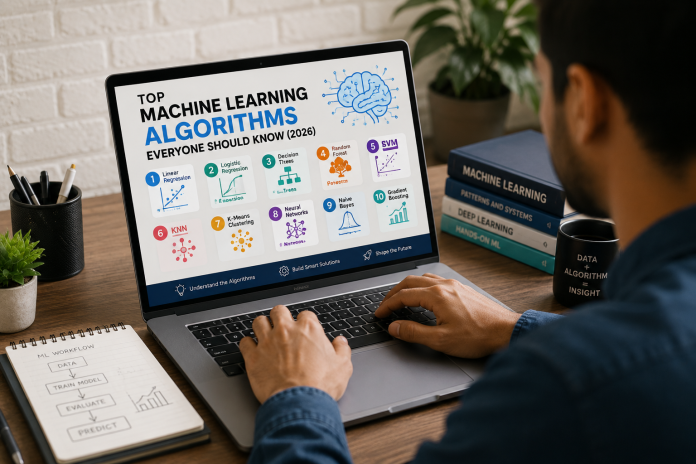
Behind every Machine Learning application from spam filters to recommendation engines lies an algorithm doing the heavy lifting. These algorithms are the mathematical foundations that allow computers to identify patterns, make predictions, and improve over time.
While there are dozens of ML algorithms in use today, a handful stand out as foundational, powering the majority of real-world applications. This guide walks through the most important Machine Learning algorithms, explained in simple, practical terms.
Why Understanding ML Algorithms Matters
You don’t need to be a data scientist to benefit from understanding ML algorithms at a conceptual level. Whether you’re a business owner evaluating AI tools, a marketer curious about personalization engines, or simply someone interested in technology, knowing how these algorithms work helps you make more informed decisions about adopting and using AI-powered systems.

1. Linear Regression
Linear Regression is one of the simplest and most widely used ML algorithms, primarily used for predicting numerical values based on input data.
How it works: It identifies a linear relationship between input variables and an output value, essentially drawing a “best fit line” through data points.
Common applications:
- Predicting sales based on advertising spend
- Estimating housing prices based on square footage and location
- Forecasting demand based on historical trends
2. Logistic Regression
Despite its name, Logistic Regression is used for classification problems rather than predicting continuous values. It estimates the probability that a given input belongs to a specific category.
How it works: It calculates probabilities and assigns data points to categories based on a defined threshold (e.g., spam vs. not spam).
Common applications:
- Email spam detection
- Customer churn prediction
- Medical diagnosis (e.g., predicting disease presence)
3. Decision Trees
Decision Trees are intuitive models that split data into branches based on decision rules, similar to a flowchart.
How it works: The algorithm asks a series of yes/no questions about the data, narrowing down to a final prediction or classification.
Common applications:
- Credit approval decisions
- Customer segmentation
- Risk assessment models
4. Random Forest
Random Forest is an extension of Decision Trees that combines multiple trees to improve accuracy and reduce overfitting.
How it works: It builds numerous decision trees using random subsets of data and combines their outputs to produce a more reliable overall prediction.
Common applications:
- Fraud detection
- Stock market prediction
- Product recommendation systems
5. Support Vector Machines (SVM)
Support Vector Machines are powerful algorithms used primarily for classification tasks, particularly effective with complex, high-dimensional data.
How it works: SVM identifies the optimal boundary (or “hyperplane”) that best separates different categories of data.
Common applications:
- Image classification
- Text categorization
- Bioinformatics (e.g., gene classification)
6. K-Nearest Neighbors (KNN)
K-Nearest Neighbors is a simple, intuitive algorithm used for both classification and regression tasks.
How it works: It classifies a data point based on the majority category of its closest neighboring data points.
Common applications:
- Recommendation systems
- Pattern recognition
- Anomaly detection
7. K-Means Clustering
K-Means is an unsupervised learning algorithm used to group data into distinct clusters based on similarity.
How it works: It partitions data into a predefined number of clusters, minimizing the distance between data points and their assigned cluster center.
Common applications:
- Customer segmentation in marketing
- Document clustering
- Image compression
8. Neural Networks
Neural Networks are inspired by the structure of the human brain, consisting of layers of interconnected “neurons” that process information.
How it works: Data passes through multiple layers, with each layer extracting increasingly complex patterns, ultimately producing a final output or prediction.
Common applications:
- Image and speech recognition
- Natural language processing
- Recommendation engines
Neural Networks form the foundation of Deep Learning, a more advanced subset of Machine Learning responsible for many recent AI breakthroughs, including generative AI tools.
9. Naive Bayes
Naive Bayes is a probabilistic algorithm based on Bayes’ Theorem, commonly used for classification tasks involving text data.
How it works: It calculates the probability of a data point belonging to a particular category based on prior observed patterns, assuming feature independence.
Common applications:
- Spam email filtering
- Sentiment analysis
- Document classification
10. Gradient Boosting Algorithms
Gradient Boosting techniques, including popular implementations like XGBoost and LightGBM, build models sequentially, with each new model correcting errors made by previous ones.
How it works: It combines multiple weak prediction models into a single, more accurate model through an iterative correction process.
Common applications:
- Competitive data science applications (e.g., Kaggle competitions)
- Credit risk modeling
- Customer behavior prediction
Choosing the Right Algorithm
Selecting the appropriate ML algorithm depends on several factors:
- Type of problem: Classification, regression, or clustering
- Size and quality of available data
- Interpretability requirements: Some algorithms, like Decision Trees, are easier to interpret than complex Neural Networks
- Computational resources available In practice, data scientists often test multiple algorithms on a given problem to determine which produces the most accurate and reliable results.
The Growing Role of Automated Machine Learning (AutoML)
As Machine Learning adoption grows, AutoML platforms have emerged to simplify the algorithm selection process. These tools automatically test multiple algorithms and configurations, making Machine Learning more accessible to businesses without dedicated data science teams.
This trend reflects a broader shift toward democratizing Machine Learning, allowing more organizations to leverage these powerful algorithms without requiring deep technical expertise.
Final Thoughts
Machine Learning algorithms form the backbone of countless applications we rely on daily, from personalized recommendations to fraud detection systems. While the technical details behind these algorithms can get complex, understanding their core concepts and use cases provides valuable insight into how modern AI-powered systems actually work.
As Machine Learning continues to evolve, staying familiar with these foundational algorithms will help you better understand and evaluate the AI tools shaping today’s digital landscape.
Frequently Asked Questions
- Which Machine Learning algorithm is best for beginners to learn first?
Linear Regression and Logistic Regression are typically recommended as starting points due to their simplicity and foundational role in understanding more complex algorithms. - What’s the difference between supervised and unsupervised algorithms?Supervised algorithms learn from labeled data with known outcomes, while unsupervised algorithms identify patterns in data without predefined labels.
- Are Neural Networks better than traditional ML algorithms?
Not necessarily. Neural Networks excel with large, complex datasets like images and text, but traditional algorithms like Decision Trees or Random Forest can be more effective and interpretable for simpler, structured data problems. - What is Gradient Boosting used for?
Gradient Boosting is commonly used for structured data problems like credit risk modeling and customer behavior prediction, often producing highly accurate results. - Do businesses need data scientists to use Machine Learning algorithms?
Not always. AutoML platforms and no-code ML tools have made it possible for businesses to leverage these algorithms without extensive in-house data science expertise.