Every business adopting AI in 2026 is asking the same question: is it actually paying off? Unlike traditional software, AI’s return is spread across saved time, better decisions, and fewer errors, which makes it genuinely harder to measure than a normal IT purchase. If you want the shorter, practical version first, our guide on measuring the ROI of AI investments in your business covers the basics. This guide goes deeper, covering what AI ROI means, how to calculate it properly, how it differs by use case, and the mistakes that make most companies get the number wrong.
What Is AI ROI
AI ROI is the return a business gets from an AI investment relative to what it cost to build, buy, and run. On paper the formula looks identical to any other ROI calculation: (Gain from Investment minus Cost of Investment) divided by Cost of Investment. In practice, AI ROI is harder to pin down for three reasons.
First, AI costs are not one-time. Licensing, fine-tuning, integration, and ongoing inference costs all show up on different timelines, so a tool that looks cheap in month one can look expensive by month six once usage scales. Second, AI benefits are often indirect. A support chatbot does not generate revenue directly, it reduces resolution time, which reduces headcount need, which shows up in the P&L two or three steps removed from the tool itself. Third, traditional software ROI compares a “before” and “after” state that is usually stable. AI performance can drift, improve with more data, or degrade as usage patterns change, so the ROI calculation is not a single number, it is a moving one you need to revisit.
How to Calculate AI ROI
The core formula stays simple. The work is in getting the inputs right.
Cost inputs to include:
- Licensing or API costs (per seat, per token, or per call, depending on the tool)
- Implementation and integration costs, including internal engineering time
- Training costs, both for fine-tuning a model and for training staff to use it
- Ongoing maintenance, monitoring, and prompt or workflow updates
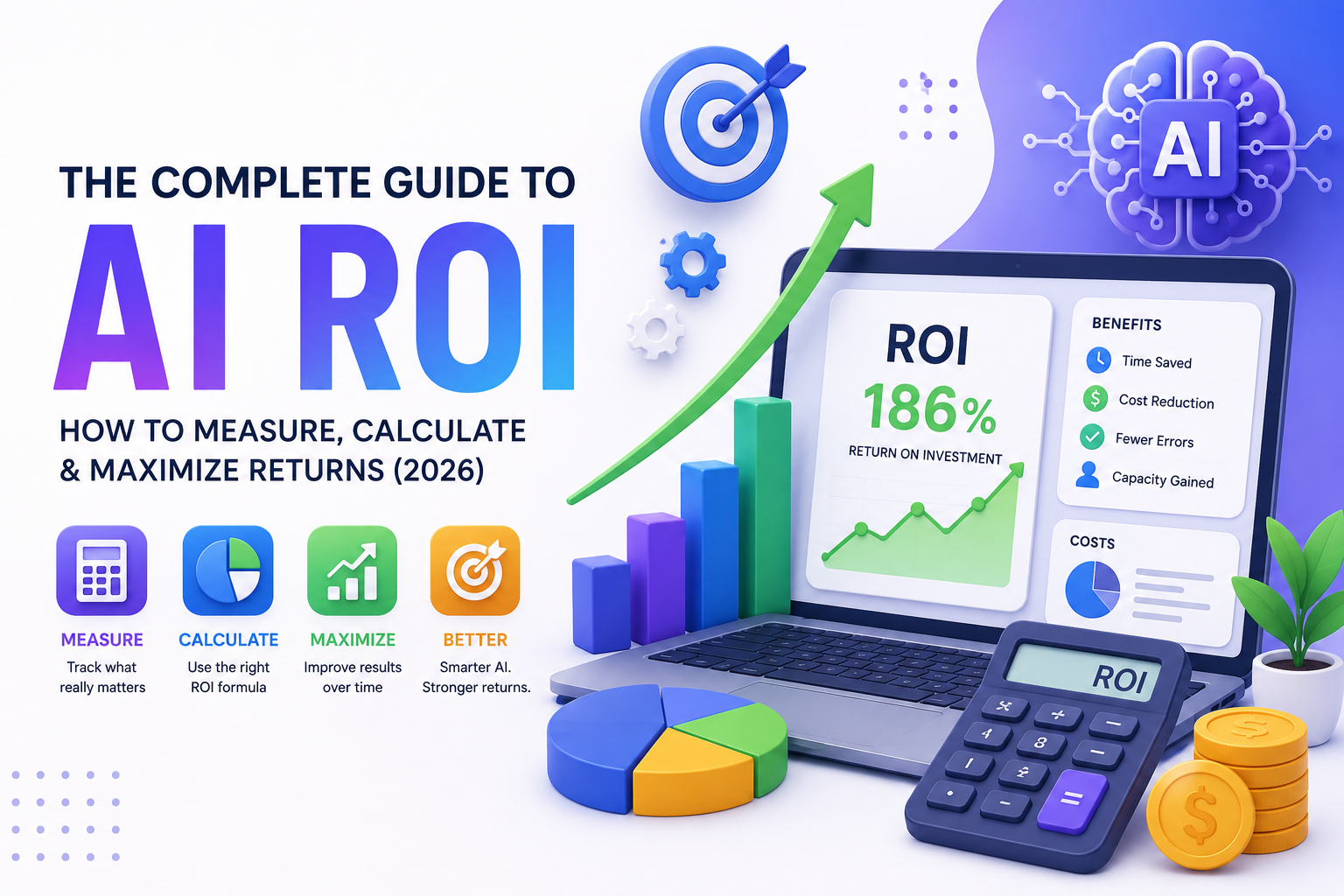
Benefit inputs to include:
- Time saved, converted to a dollar value using the hourly cost of the people whose time was freed up
- Revenue lift, where AI directly contributes to conversion, upsell, or retention
- Error reduction, valued using the average cost of the error being prevented (a support ticket, a compliance mistake, a shipping error)
- Capacity gained, meaning work the team can now take on without hiring, valued at the cost of the hire avoided
A useful practice is to set a baseline before rollout, the exact metric you expect AI to move (average handle time, tickets per agent, hours spent on a task) and measure that same metric 60 to 90 days after adoption. Without a baseline, any ROI number afterward is a guess dressed up as data.
AI ROI by Use Case
Customer Support AI
The clearest ROI case in most companies. Track average handle time, first-contact resolution rate, and tickets deflected from human agents entirely. A support AI that deflects even 20 percent of tickets at a large volume can pay for itself within a quarter, but only if you also track customer satisfaction alongside deflection, since a cheaper resolution that damages satisfaction is a false win.
Content and Marketing AI
Harder to measure directly because content has a delayed and indirect effect on revenue. Track content output volume against team size, time from brief to publish, and downstream metrics like organic traffic or lead volume per piece published. Compare cost per piece before and after AI adoption rather than trying to attribute revenue to a single blog post or ad variation.
Sales AI
Track win rate, average deal cycle length, and rep capacity (deals worked per rep per month). AI tools that summarize calls, draft follow-ups, or score leads should show up as either more deals per rep or a shorter cycle time, and ideally both. If neither number moves within a quarter, the tool is not earning its cost regardless of how it feels to use.
Internal Automation
The most straightforward ROI case: hours of manual work removed multiplied by the hourly cost of the people doing that work, minus the cost of building and maintaining the automation. The risk here is undercounting maintenance cost, since automations built quickly often need ongoing fixes as source systems change, which quietly erodes the ROI over time if nobody is tracking it.
Enterprise AI ROI
At enterprise scale, AI ROI calculations need to account for a few things smaller teams can skip. Procurement and compliance overhead is real cost, security review, data governance, and legal review on vendor contracts all take internal time that should be counted. Change management cost also matters. A tool with strong theoretical ROI that nobody adopts because of poor rollout delivers zero actual return, so training and internal champion time belongs in the cost column, not treated as free.
Enterprises should also expect a longer payback window than smaller teams, often two to four quarters rather than one, because integration with legacy systems and multiple stakeholder approval cycles slow time to value. Budgeting for that reality up front avoids the common trap of killing a promising AI project after one disappointing quarter when the real payoff was always going to show up in quarter three.
Common Mistakes in Measuring AI ROI
- Vanity metrics over business metrics. Usage numbers (queries run, messages sent) feel like progress but do not prove value. Tie every metric back to a cost saved or revenue gained.
- No baseline before rollout. Without a “before” number, any “after” number is unverifiable.
- Ignoring the cost of human oversight. Most AI systems still need human review, and that review time is a real cost that often gets left out of the calculation entirely.
- Measuring too early. Many AI tools have a learning curve for both the model and the team using it. A 30-day ROI check often understates the real return you would see at 90 days.
- Comparing to zero instead of to the alternative. The right comparison is not “AI versus doing nothing,” it is “AI versus the next best alternative,” which is usually hiring or a cheaper non-AI tool.
A Simple AI ROI Framework You Can Use Today
For a quick working estimate, run these four steps on any AI tool you are evaluating or already using:
- Set a baseline metric. Pick one number that matters (hours spent, tickets resolved, deals closed) and record it before AI touches the process.
- Total the real cost. Licensing plus implementation plus training plus a realistic maintenance estimate, not just the subscription price.
- Measure the same metric at 90 days. Compare against baseline and convert the difference into a dollar value using hourly cost, revenue per deal, or cost per error avoided.
- Calculate and revisit quarterly. Apply the standard ROI formula, then recheck it every quarter since AI tool costs and performance both shift over time.
This will not give you boardroom-grade precision on day one, but it gives you a defensible number instead of a guess, and a defensible number is what actually gets AI budgets approved and renewed. For the automation side of this equation, our step-by-step guide to automating tasks with AI walks through the implementation side that feeds directly into this ROI calculation, and our roundup of how AI agents are changing software in 2026 covers where a lot of this ROI is currently being unlocked.
Frequently Asked Questions
How do you measure the ROI of AI investments?
Set a baseline metric before rollout, total the full cost including licensing, implementation, training, and maintenance, then measure the same metric again at 90 days and convert the difference into a dollar value to apply the standard ROI formula.
What is a good ROI for an AI investment?
There is no universal number, but most well-scoped internal automation and support AI projects should show a positive, measurable return within one to two quarters. Enterprise projects with heavier integration often take two to four quarters to reach the same point.
How do you calculate ROI on enterprise AI investments?
Include procurement, compliance, and change management costs alongside the tool cost itself, expect a longer payback window than smaller-team deployments, and measure against the next best alternative rather than against doing nothing.
Why is AI ROI hard to measure compared to regular software ROI?
AI costs are ongoing and usage-based rather than one-time, and AI benefits are often indirect (time saved, fewer errors) rather than a direct revenue line, which makes both sides of the ROI formula harder to pin down than a typical software purchase.
What are common mistakes companies make measuring AI ROI?
The most common mistakes are tracking usage instead of business impact, skipping a baseline measurement before rollout, leaving out the cost of human review time, and measuring too early before the tool and team have adjusted to it.
How do you calculate ROI for AI in customer support specifically?
Track average handle time, first-contact resolution, and ticket deflection rate, convert the time saved into dollar value using agent hourly cost, and weigh it against any drop in customer satisfaction to avoid a false win.