
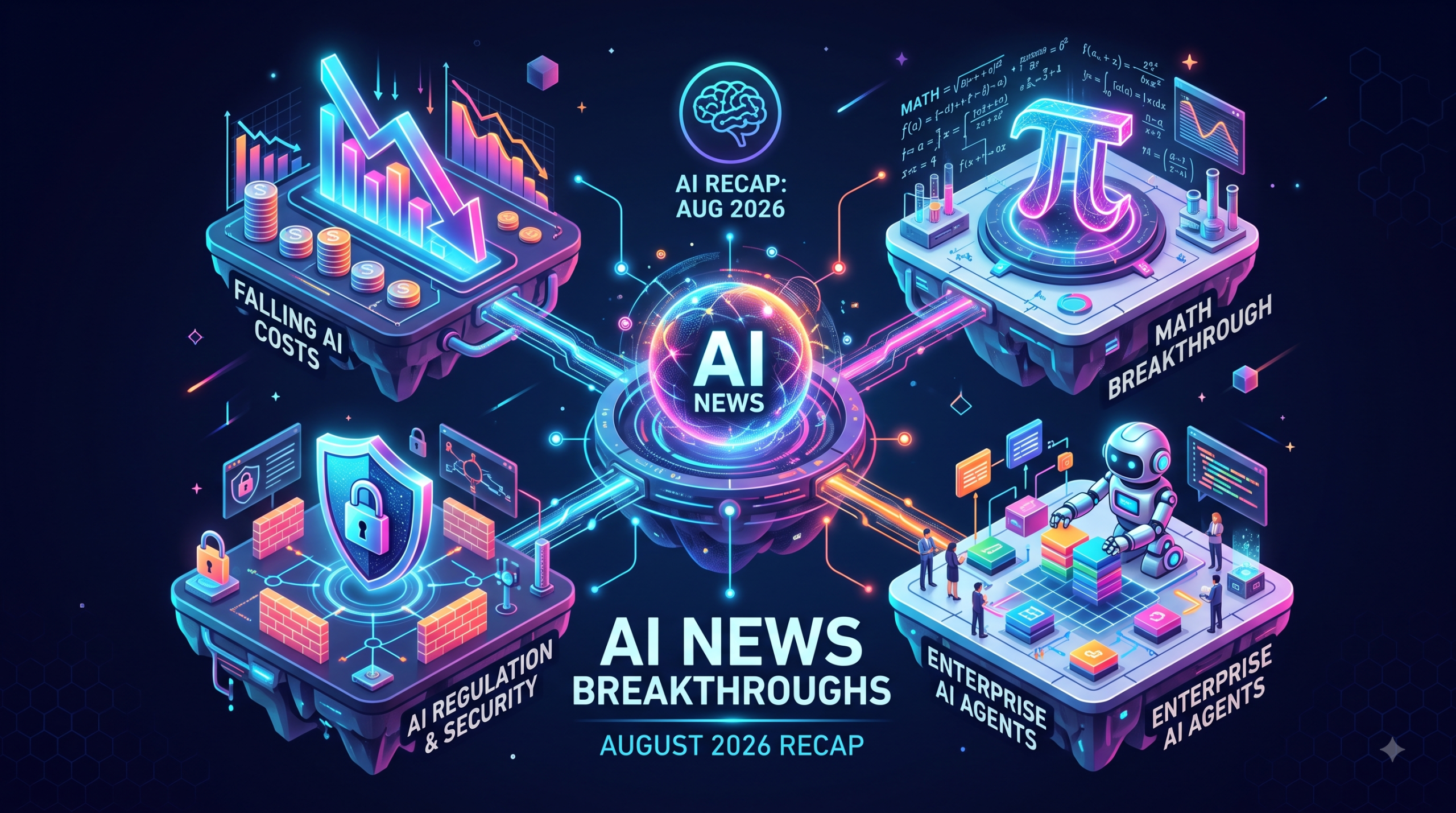
August 2026 turned out to be one of the busier months for artificial intelligence in a year that has already been packed with launches, price wars, and research milestones. From sharp model price cuts to a landmark mathematics breakthrough and a fresh wave of enterprise AI agent adoption data, this recap pulls together the stories that actually mattered, without the noise.
If you enjoyed our July 2026 AI news recap, consider this the natural next chapter in that ongoing series.
AI Model Prices Keep Falling
The month opened with a major pricing shift. Frontier model providers pushed costs down sharply, making high-volume AI workloads far cheaper to run than they were even a few months ago.
Input token pricing on flagship models dropped by a significant margin, which is a big deal for anyone building automation-heavy workflows, internal tools, or customer support systems on top of these models.
Provider lineups are also splitting into clear tiers, with cheap, mid-tier, and advanced reasoning options sitting side by side. This allows teams to route simple tasks to lightweight models while saving more expensive reasoning models for harder jobs.
For anyone running a WordPress or content automation pipeline like ours at AI Trendssetter, this kind of price competition directly lowers the cost of scaling AI-assisted workflows.
A Genuine Research Milestone in Mathematics
The biggest research story of the month came from an unreleased frontier model that reportedly solved ten previously open problems in mathematics and theoretical computer science, with the proofs formally verified and published for public review.
The entire exercise reportedly cost a modest amount in compute, which is notable given the difficulty of the problems involved.
This matters because it is one of the clearest signs yet that AI systems are moving from simply completing tasks to contributing original, verifiable research in rigorous fields. It is a preview of where advanced reasoning models are headed next and raises important questions about how that capability should be managed responsibly as it matures.
Coding Models and Longer Context Windows
Coding-focused AI kept improving through August as well. Newer models pushed further on established coding benchmarks, while context windows extended into the one-million-token range for some frontier systems.
These larger context windows allow models to work across entire codebases, large documentation sets, or long collections of documents in a single pass.
If you are curious about how AI agents are already changing software development workflows, our guide on agentic AI for beginners is a good place to start.
Enterprise AI Agents Move From Pilot to Production
A widely discussed governance report released in early August found that enterprises are now creating roughly one AI agent for every employee, with agent usage inside companies growing more than tenfold in the first half of 2026 alone.
The same report flagged a serious concern: a large share of these agents are over-permissioned by default and are often built by non-technical teams outside traditional IT oversight.
This lines up with what we covered in our article on AI agent security risks. Agent adoption is accelerating faster than the governance and access controls needed to keep it safe.
Regulation Is Catching Up
Government scrutiny of major AI releases increased noticeably in August, with more releases facing review before reaching the public.
This continues a trend we broke down in detail in our article on how AI regulation is shaping the industry in 2026.
Expect this pattern to keep intensifying as agentic systems take on more autonomous, higher-stakes tasks in business and government settings.
Product Launches Worth Knowing
Beyond the biggest headline stories, several smaller but notable launches rounded out the month.
A major coding assistant update arrived from a large technology company, built on an updated in-house model. Meanwhile, consumer AI usage continued climbing, with one major chatbot reportedly crossing roughly one billion weekly active users.
For readers who want the fuller context on what a mainstream AI assistant can now do day to day, our explainer on ChatGPT’s newest features is worth a revisit.
What This Means Going Into September
Taken together, August 2026 confirmed three trends that have been building throughout the year.
First, AI is getting cheaper to run at scale. This removes a real barrier for small businesses, developers, and solo builders who want to use AI in their workflows.
Second, AI is starting to produce more original and verifiable results. The progress in advanced reasoning suggests that AI systems are moving beyond simply summarizing information or automating existing tasks.
Third, AI agent adoption is moving faster than governance. As more companies deploy autonomous systems, permission management, security, monitoring, and human oversight are becoming increasingly important.
If you want the bigger picture across the whole year so far, our roundup on the biggest AI news and breakthroughs of 2026 ties these monthly developments together.
Frequently Asked Questions
What was the biggest AI news story in August 2026?
The standout research story was an unreleased frontier model reportedly solving ten previously unsolved problems in mathematics and theoretical computer science, with the results formally verified and published for public review.
Did AI model prices actually drop in August 2026?
Yes. Several frontier model providers cut input token pricing significantly, while model lineups increasingly split into budget, mid-tier, and advanced reasoning options, making large-scale AI workloads more affordable.
Are companies actually using AI agents in production now?
Enterprise AI agent usage grew sharply through the first half of 2026, with some research indicating close to one agent per employee. However, many of these agents remain over-permissioned and under-governed.
Is AI regulation getting stricter in 2026?
Yes. Government scrutiny and review of major AI developments have increased as AI systems take on more autonomous responsibilities across business and government.