
Machine Learning (ML) is one of the most important technologies driving today’s AI revolution. It powers everything from the spam filter in your inbox to the recommendation engine on your favorite streaming service. Yet for many people, the term “Machine Learning” still feels abstract or overly technical.
This guide breaks down Machine Learning in simple, practical terms what it is, how it works, and why it’s become such a foundational part of modern technology.
What Is Machine Learning?
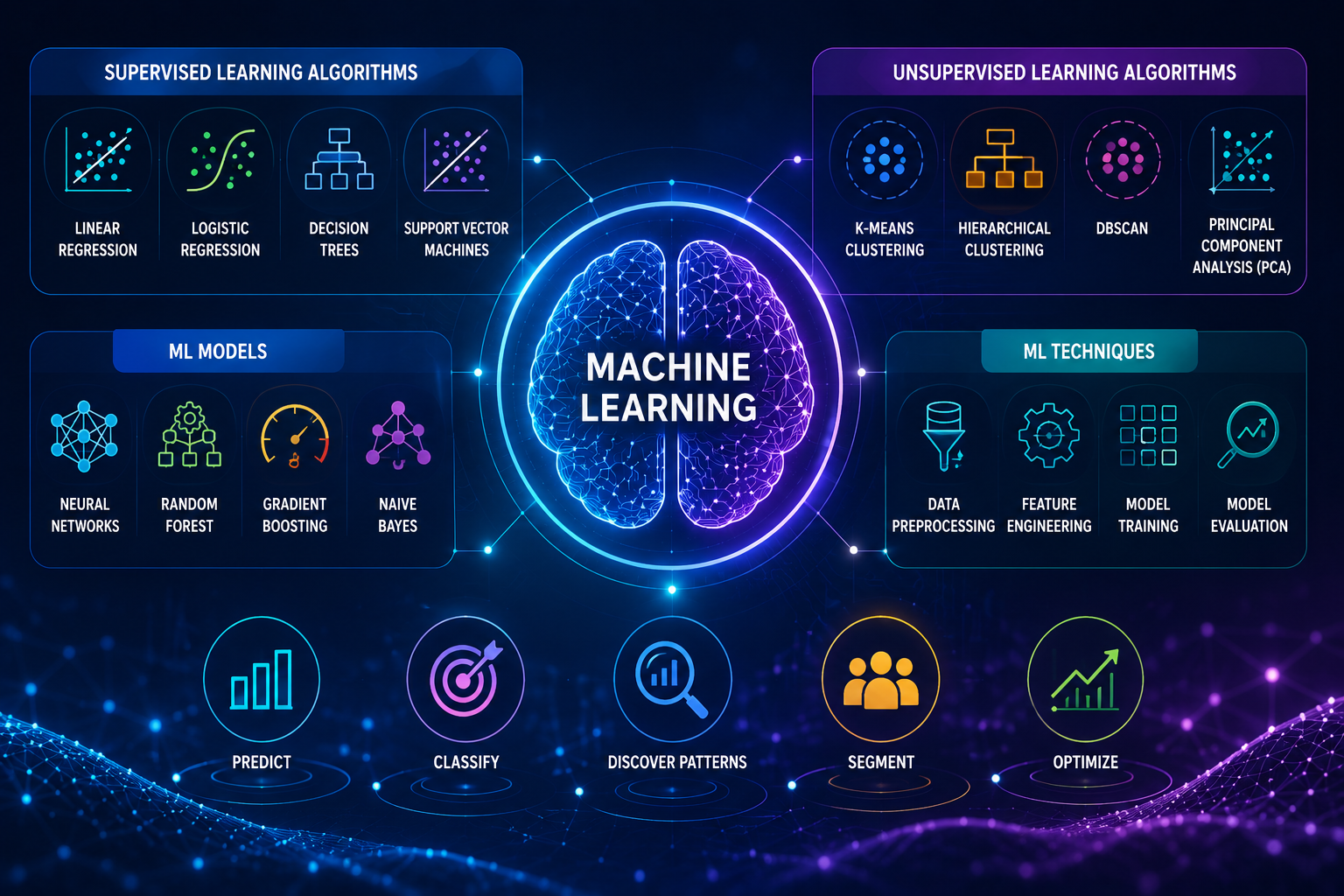
Machine Learning is a subset of Artificial Intelligence that enables computer systems to learn from data and improve their performance over time without being explicitly programmed for every possible scenario.
Instead of following fixed, rule-based instructions, ML systems analyze large amounts of data, identify patterns, and use those patterns to make predictions or decisions. The more relevant data an ML model processes, the better it typically becomes at its task.
In simple terms: Machine Learning is how computers learn from experience, much like humans learn from practice.
How Is Machine Learning Different from Traditional Programming?
Traditional programming involves writing explicit instructions for every task a computer needs to perform. If you want a program to identify spam emails, you’d need to manually write rules for every possible spam pattern.
Machine Learning takes a different approach. Instead of writing explicit rules, you feed the system large amounts of labeled data (e.g., emails marked as “spam” or “not spam”). The ML model analyzes this data, identifies patterns, and creates its own internal rules for making predictions on new, unseen data.
This ability to learn from data rather than relying solely on human-written rules is what makes Machine Learning so powerful and adaptable.
The Three Main Types of Machine Learning
1. Supervised Learning
In supervised learning, the model is trained on labeled data, meaning each piece of input data has a corresponding correct output. For example, an email dataset labeled as “spam” or “not spam” would be used to train a spam detection model.
Common applications include:
- Email spam filtering
- Credit scoring and risk assessment
- Image classification
2. Unsupervised Learning
Unsupervised learning involves training models on data without labeled outcomes. The system identifies patterns, groupings, or structures within the data on its own.
Common applications include:
- Customer segmentation in marketing
- Anomaly detection in fraud prevention
- Recommendation systems based on behavior patterns
3. Reinforcement Learning
Reinforcement learning involves training a model through trial and error, using a system of rewards and penalties. The model learns to make decisions by maximizing positive outcomes over time.
Common applications include:
- Game-playing AI systems
- Robotics and autonomous navigation
- Optimizing business processes over time
How Machine Learning Models Are Trained
Training a Machine Learning model typically involves several key steps:
- Data Collection: Gathering relevant, high-quality data related to the task at hand.
- Data Preprocessing: Cleaning and organizing data to ensure accuracy and consistency.
- Model Selection: Choosing an appropriate algorithm based on the type of problem being solved.
- Training: Feeding data into the model so it can learn patterns and relationships.
- Evaluation: Testing the model’s accuracy using data it hasn’t seen before.
- Deployment: Implementing the trained model into real-world applications.
This process is often iterative, with models being refined and retrained as new data becomes available.
Real-World Applications of Machine Learning
Machine Learning has become deeply embedded in everyday technology:
- Streaming services like Netflix and Spotify use ML to recommend content based on viewing or listening history.
- E-commerce platforms use ML to personalize product recommendations and predict customer behavior.
- Financial institutions use ML for fraud detection and credit risk assessment.
- Healthcare providers use ML to assist in diagnosing diseases based on medical imaging and patient data.
- Social media platforms use ML to curate personalized feeds and detect harmful content.
These applications demonstrate how Machine Learning has moved beyond theoretical research into practical, everyday use.
Why Machine Learning Matters for Businesses
Businesses across industries are increasingly adopting Machine Learning to gain a competitive edge. Key benefits include:
- Improved decision-making: ML models can analyze data far faster and more accurately than manual methods.
- Personalization at scale: Businesses can deliver personalized experiences to thousands or millions of customers simultaneously.
- Operational efficiency: ML-driven automation reduces manual workload and improves accuracy in repetitive tasks.
- Predictive insights: ML models can forecast trends, customer behavior, and potential risks before they occur.
For small and medium-sized businesses, cloud-based ML tools have made these capabilities more accessible than ever, removing the need for extensive in-house technical expertise.
Common Misconceptions About Machine Learning
- “Machine Learning is the same as AI.” ML is a subset of AI, not the entire field. AI encompasses broader concepts, while ML specifically refers to systems that learn from data.
- “ML models are always accurate.” ML models can make mistakes, especially if trained on biased, incomplete, or poor-quality data.
- “ML requires massive datasets to be useful.” While more data generally improves performance, smaller, well-curated datasets can still produce effective models for specific tasks.
Getting Started with Machine Learning
For those interested in learning more about Machine Learning, here are some practical starting points:
- Learn the basics of statistics and data analysis, as these form the foundation of ML concepts.
- Experiment with beginner-friendly ML platforms that don’t require coding, such as no-code ML tools.
- Explore introductory online courses covering ML fundamentals and popular algorithms.
- Follow real-world case studies to understand how businesses apply ML in practice.
Final Thoughts
Machine Learning has transformed from a niche academic field into a foundational technology powering countless applications we use every day. By enabling systems to learn from data rather than relying on fixed rules, ML has unlocked new levels of automation, personalization, and predictive capability across virtually every industry.
Understanding the basics of Machine Learning how it works, its main types, and its real-world applications provides a strong foundation for anyone looking to navigate today’s increasingly data-driven world.
Frequently Asked Questions
- What is Machine Learning in simple terms?
Machine Learning is a branch of AI that allows computers to learn from data and improve their performance over time, without being explicitly programmed for every scenario. - What are the main types of Machine Learning?
The three main types are supervised learning, unsupervised learning, and reinforcement learning, each suited to different types of problems. - Is Machine Learning the same as Artificial Intelligence?
No. Machine Learning is a subset of AI. AI is the broader concept of machines simulating human intelligence, while ML is one specific approach used to achieve that. - What industries use Machine Learning the most?
Industries like finance, healthcare, retail, and marketing rely heavily on Machine Learning for tasks like fraud detection, personalized recommendations, and predictive analytics. - 5. Do I need to know how to code to understand Machine Learning?
No. While coding is necessary for building ML models, understanding ML concepts at a foundational level doesn’t require any technical or coding background.