

Prompt Engineering Framework: A Step by Step System for Better AI Results in 2026
Most people who use ChatGPT or Claude every day still write prompts the same way they type a search query. They type a short line, get a mediocre answer, and either accept it or try again with slightly different words. That trial and error approach works occasionally, but it wastes time and rarely produces the kind of output that actually saves work.
A prompt engineering framework fixes this. Instead of guessing, you follow a repeatable structure every time you write a prompt, which means you get consistent, usable results instead of random ones. This guide breaks down a simple five part framework you can start using today, along with real examples and common mistakes to avoid.
Why Most Prompts Fail
Before looking at the framework, it helps to understand why so many prompts underperform. Three problems come up again and again.
The first is vagueness. A prompt like “write a marketing email” gives the model almost nothing to work with, so it fills in the gaps with generic assumptions.
The second is missing context. The model does not know your audience, your brand voice, or your goal unless you tell it, so it defaults to a neutral, average response.
The third is an undefined output format. If you do not specify length, structure, or tone, you will often get a wall of text that needs heavy editing before it is usable.
The framework below is built specifically to solve these three problems.
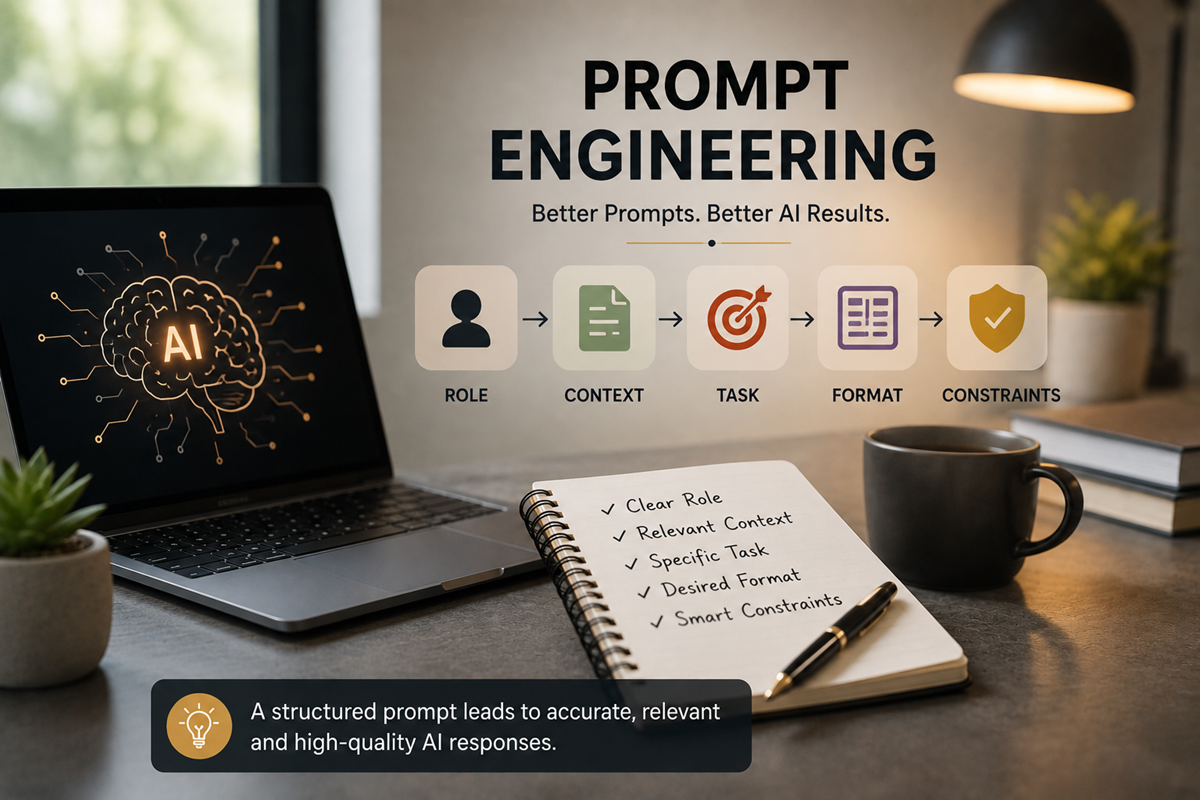
The Five Part Prompt Engineering Framework
1. Role
Start by telling the model who it should act as.
This sets the tone, vocabulary, and depth of the response.
For example,
“Act as a senior SEO strategist.”
produces a very different answer than
“Act as a beginner blogger.”
even for the same question.
2. Context
Give the model the background it needs.
This includes your:
- Goal
- Audience
- Industry
- Platform
- Relevant constraints
Context is usually the single biggest lever for improving output quality because it removes the guesswork.
3. Task
State exactly what you want done, using a clear action verb.
Instead of:
“Help me with content.”
Write:
“Write a 300 word LinkedIn post.”
or
“Summarize this article in five bullet points.”
Specific tasks get specific results.
4. Format
Tell the model how the output should look.
For example:
- Numbered list
- Table
- Specific word count
- Formal tone
- Conversational tone
Skipping this step is one of the most common reasons people have to heavily rewrite AI output.
5. Constraints
Add any limits or rules the response must follow.
For example:
- Avoid certain words
- Stay under a character limit
- Include specific keywords
- Follow a particular writing style
Constraints act as guardrails that keep the model from wandering off track.
A Real Example
Weak Prompt
Write about AI in customer service.
Framework Based Prompt
Act as a customer experience consultant. My audience is small business owners who are new to AI tools and want practical, low cost solutions. Write a 400 word blog introduction explaining how AI improves customer service, using a conversational tone and no technical jargon. Do not mention any specific software brand names.
The difference in output quality between these two prompts is significant, and it comes entirely from structure, not from clever wording.
Advanced Techniques Once You Know the Basics
Once the five part framework feels natural, a few advanced techniques can push results even further.
Chain of Thought Prompting
Ask the model to reason step by step before giving a final answer.
This is especially useful for analysis or planning tasks.
Few Shot Prompting
Give the model one or two examples of the output style you want.
This is one of the fastest ways to get consistent formatting.
Iterative Refinement
Treat the first response as a draft, then ask for specific improvements rather than starting over.
This usually gets to a strong result faster than rewriting the whole prompt.
These techniques build directly on the same five part structure.
They do not replace it.
Common Mistakes to Avoid
Even with a good framework, a few habits quietly reduce prompt quality.
- Writing extremely long prompts packed with unrelated instructions.
- Skipping examples when the output format is unusual.
- Reusing the exact same prompt across very different tasks.
- Ignoring the importance of context.
Small adjustments based on the specific task usually matter more than a longer prompt.
Building Your Own Prompt Library
Once you are comfortable with the framework, it is worth saving prompts that consistently produce good results as templates.
Group them by task type, such as:
- Content writing
- Research summaries
- Customer replies
- Marketing
- Coding
Keep placeholders for the parts that change, like audience or topic.
Over time, this turns prompt writing from a repeated guessing game into a fast, repeatable process, which is especially useful for anyone using AI tools daily for work.
Final Thoughts
Prompt engineering is not about finding secret phrases or magic words.
It is about giving the model clear role, context, task, format, and constraints every time, the same way you would brief a new team member on a task.
Once this becomes a habit, the quality gap between a rushed one line prompt and a well structured one becomes obvious, and it applies whether you are using ChatGPT, Claude, or any other large language model.
If you want to go deeper, this framework pairs well with our guide on 7 advanced prompt engineering techniques for better AI results, and our practical templates for using prompt engineering in a business setting.
📖 Read Also:
7 Advanced Prompt Engineering Techniques for Better AI Results |
Prompt Engineering for Business: Practical Templates and Examples