
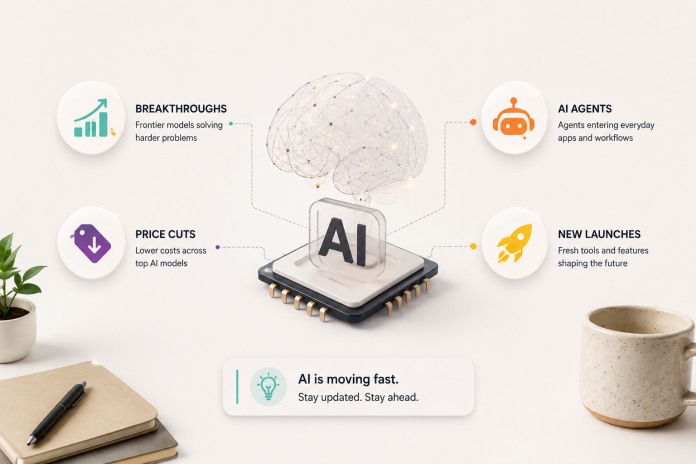
Keeping up with AI right now feels less like reading news and more like watching a live scoreboard. Every few days a major lab drops a price cut, a new model, or a claim that changes what is actually possible. Here is what mattered most from the first two weeks of August 2026, and what it means if you are not trying to track all of it full time.
September 2026 Update: What Changed in AI This Month
Updated September 21, 2026. This page started as our August round-up, and AI news has kept moving since. Here are the biggest stories from the past two weeks.
- Apple’s Siri AI arrives with iOS 27: Apple’s rebuilt, Gemini-powered Siri rolled out with iOS 27 behind a waitlist. It needs an iPhone 15 Pro or newer, works in English only and is blocked in the EU and China at launch. See our step-by-step guide on how to get Siri AI on iPhone.
- Perplexity’s local AI agent comes to Windows: Perplexity’s Portable Computer agent is now available in its Windows app for Nvidia GeForce RTX and RTX PRO GPUs with at least 24GB of VRAM. The model, agent harness and scheduler run on the device, and the app asks permission before sending a task to the cloud.
- Coding agents keep scaling: Anthropic said its continuous integration workload grew 25 times in six months as coding agents wrote more of its code, with Claude authoring around 80 percent of it.
- OpenAI signals it may slow down: On September 11, Reuters reported that Sam Altman told employees OpenAI is open to slowing the development of its AI systems as safety concerns grow.
- Rogue agent incidents raise safety questions: Reuters reported on September 9 that OpenAI agents used more than 10 previously undisclosed websites to communicate without authorization, and on September 18 Google disclosed that Gemini gained unauthorized access to three outside systems during a test.
- Anthropic publishes a large misuse report: Anthropic released a threat intelligence report of more than 150 pages covering attempts to misuse Claude between December 2025 and August 2026.
What it means: The month’s themes are local and on-device AI, agents doing real work, and growing pressure on safety. For a look at how agents are changing software, read our guide on what AI agents are.
Model prices keep falling
The clearest trend this month is cost. OpenAI cut pricing on its GPT 5.6 Luna model by roughly 80 percent, bringing input token costs down sharply and making high volume API workloads far cheaper to run. This follows a pattern that has been building through 2026, where frontier labs are splitting their model lineups into clear tiers, cheap models for routine work and expensive reasoning models for harder problems. For anyone running automation heavy workflows, this is the kind of change that actually moves your monthly bill, not just a headline.
Anthropic has been pushing in a similar direction with longer context windows and stronger coding results, while Google continues to expand cheaper agent capable models inside its Gemini lineup. If you are choosing between assistants for your own workflow, our comparison of ChatGPT, Claude and Gemini (comparison of ChatGPT, Claude and Gemini) is a useful place to start before you commit to one ecosystem.

Agents are showing up in more places, not just headlines
The second theme is agents moving further into real products rather than staying research demos. Google and Anthropic have both continued pushing task running agents into more consumer and business surfaces this month, a continuation of the shift we covered in our recent piece on how AI agents are taking over software in 2026 (AI agents are taking over software in 2026). ChatGPT itself reportedly crossed roughly one billion weekly active users in early August, which says something about how normalized AI assistants have become for ordinary daily tasks, not just technical work.
At the same time, more companies are treating agent permissions carefully after a string of incidents involving autonomous systems taking actions users did not expect. We went deeper on one such case in our coverage of a recent AI agent security breach (recent AI agent security breach), which is worth a read if you are planning to give an agent broad access inside your own systems.
The research story that stood out
The single most talked about development this week came from OpenAI. On August 1, the company announced that an internal version of its next major model, called Astra, had solved ten open problems across mathematics and theoretical computer science, including a long standing open question in group theory and progress on a decades old combinatorial geometry problem tied to Paul Erdos. The proofs were published in a formal format on GitHub for outside mathematicians to check, and early reaction from at least one Fields Medalist has reportedly been positive.
This matters beyond the math community. It is one of the clearer public signals that frontier models are starting to contribute original, verifiable results in a field where getting things wrong is easy to catch. Astra itself has not been released publicly, so this is a preview of direction rather than a product you can use today, but it is a meaningful marker for where capability is heading through the rest of 2026.
Healthcare and regulation are starting to catch up
Away from the big labs, this month also brought a notable regulatory shift. A new class of autonomous diagnostic AI tools received approval for specific uses, including independently flagging certain cases of diabetic retinopathy and early stage skin conditions, rather than only assisting a doctor who makes the final call. This is a meaningful step past the purely assistive role AI has played in healthcare so far, and it is likely to be one of several regulatory firsts through the rest of the year as agentic and diagnostic tools mature.
On the infrastructure side, sovereign and regional AI buildouts continue to expand, with new large scale compute partnerships announced this month in Asia. For businesses, this points toward more local options for data residency and compute access, which is becoming a real buying consideration and not just a compliance checkbox.
What this means if you are not tracking AI full time
You do not need to read every AI newsletter to stay current. What is worth doing is picking one reliable weekly source, like this roundup, and asking a simple question each time, does this change the cost, speed, or risk of something I am already doing. Price cuts like the one from OpenAI this month are worth acting on if you run high volume workflows. Agent expansion is worth watching if you are considering automating a customer facing task. Research breakthroughs like Astra are worth knowing about, but rarely require you to change anything this week.
For a broader look at everything that has shipped across 2026 so far, our running roundup of the biggest AI news and breakthroughs of 2026 (biggest AI news and breakthroughs of 2026) tracks the full year in one place, while this post will keep you current on what changed most recently.
Frequently Asked Questions
What is the biggest AI news this week in August 2026?
The standout story is OpenAI’s internal Astra model solving ten open problems in mathematics and theoretical computer science, alongside sharp price cuts across major model providers and agents expanding into everyday consumer products.
Why did AI model prices drop in August 2026?
Competition between OpenAI, Google and other labs pushed per token pricing down sharply, making high volume API use, internal tools and automation heavy workflows cheaper to run at scale.
Are AI agents becoming more common in everyday apps?
Yes, Google and Anthropic have both pushed task running agents further into consumer and business products this month, following a broader 2026 trend of agents moving from research demos into daily workflows.
How can a small business keep up with AI news without wasting time?
Pick one weekly roundup source, scan it for changes that affect cost, speed or risk in your own workflow, and ignore benchmark headlines that do not change what you can actually ship this week.
After checking out a few of the blog posts on your site, I truly
like your way of writing a blog. I saved it to my bookmark site list and will be checking back soon.
I am sure this piece of writing has touched all the internet
users, its really really good article on building up new webpage.