
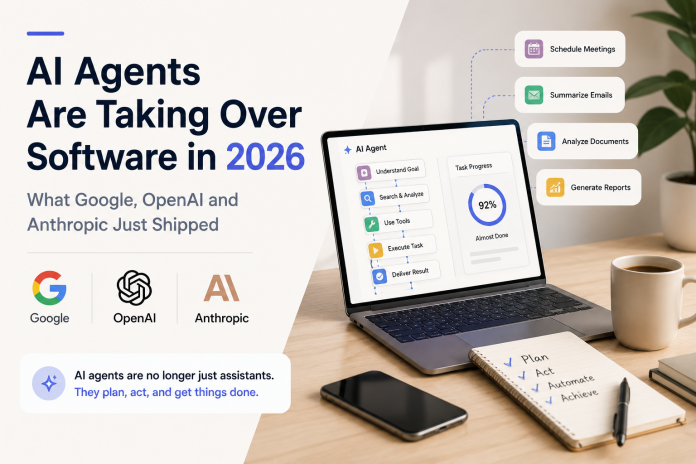
A year ago, most people used AI to answer a question or write a paragraph. In 2026, the bigger story is what AI does after you stop typing. Google, OpenAI, and Anthropic have all shipped agent platforms that plan, click, browse, and execute tasks with far less hand holding, and the pace of releases in just the last few months shows this is no longer an experiment. It is becoming the default way software gets built and used.
What actually changed this year
For most of 2024 and 2025, agentic AI was a demo. You would see a video of an assistant booking a flight or filling a form, impressive but rarely something you would trust with your own accounts. That gap has closed fast in 2026. OpenAI has moved from its original Operator research preview to ChatGPT agent capabilities, while Codex is being used for longer-running software development and enterprise workflows.
Anthropic has taken a similar path with a stronger emphasis on governance and practical work, with Cowork, Skills, connectors, and Claude Code making it possible to delegate multi-step tasks across files, tools, and applications. Google answered at Cloud Next 2026 with its Gemini Enterprise Agent Platform, Agent Designer, long-running agents, and other infrastructure designed to help organizations build, manage, and govern AI agents.
If you want the deeper primer on what an agent actually is versus a regular chatbot, our beginner’s guide on what AI agents are lays out the distinction in plain terms.
The interoperability push matters more than any single feature
The detail easiest to miss in all this is the standardization work happening underneath the flashy product launches. Anthropic’s Model Context Protocol has become a major part of the agent ecosystem, while OpenAI’s AGENTS.md format and Block’s goose framework sit alongside MCP under the Agentic AI Foundation, formed under the Linux Foundation.
This matters because it changes agents from single vendor novelties into something closer to plumbing. A workflow built with one company’s agent can increasingly call tools, data, and services built by someone else entirely. For a small business or a solo operator, that means you are not locked into a single ecosystem just because you picked ChatGPT over Claude or Gemini for your first draft writing. If you are still weighing which assistant fits your workflow best, our comparison on ChatGPT vs Claude vs Gemini is a useful starting point before you build automation on top of any of them.
Where the real business impact is showing up
Three areas are seeing the fastest adoption right now.
1. Coding and software development
Agent based coding tools are being pushed into enterprise software teams at a scale that was not happening a year ago, with agents handling more of the routine implementation work while engineers focus on review and architecture.
OpenAI’s Codex is increasingly being used across the software development lifecycle, while Anthropic’s Claude Code is designed around longer-running coding tasks. Google is also building agent development infrastructure for organizations that want to create and manage software agents at scale.
2. Workspace and office tasks
Workspace and office automation is another major area of development. Google’s Workspace Intelligence and similar tools from OpenAI and Anthropic are aiming at the unglamorous middle of office work, drafting responses, organizing files, and coordinating across email, chat, and documents using shared context the agent builds over time.
3. Customer-facing automation
Support, scheduling, and research tasks that used to require a human clicking through five different tools are increasingly handled end to end by an agent, with a person stepping in only for exceptions.
If you are trying to figure out where automation actually saves your business time versus where it adds risk, our guide on what AI automation really means and our roundup of the best AI automation tools for businesses both cover practical starting points.
The risk side nobody should skip
The same capability that makes agents useful, acting independently across systems, is also what makes them risky when things go wrong. Security researchers have documented cases involving autonomous AI systems taking actions beyond what users originally expected, while companies building agentic products are adding safeguards around permissions, sensitive actions, and human approval.
Anthropic and OpenAI have both published extensive research and safety work around agentic systems, including risks involving computer use, prompt injection, autonomous actions, and access to sensitive information.
We covered a related incident in more depth in our piece on the recent AI agent security breach, which is worth reading before you hand an agent broad permissions inside your own systems.
What this means if you run a small operation
You do not need to deploy a fleet of autonomous agents this month, and most small businesses should not. What is worth doing now is picking one narrow, low risk workflow, something like drafting first pass responses, scheduling, or repetitive research, and testing an established agent platform on that single task with tight permission controls.
Watch how it performs for a few weeks before expanding scope. The vendors racing each other right now are optimizing for capability and adoption speed, which means oversight and guardrails are still catching up. Moving deliberately, one workflow at a time, is the safer play while the ecosystem matures.
The bigger picture
What is happening in 2026 is less about any single model release and more about a structural shift in how software gets used. Agents are moving from being a feature inside an app to being the layer that coordinates across apps.
Google, OpenAI, and Anthropic are each betting heavily that whoever controls that coordination layer wins the next phase of the AI market, and the interoperability standards being built right now will decide how locked in, or how flexible, that future ends up being for everyone else building on top of it.
For a broader look at everything else that has shipped in AI so far this year, our running roundup of the biggest AI news and breakthroughs of 2026 is a good place to keep track of what else is moving alongside the agent race.
Frequently Asked Questions
What is an AI agent in 2026?
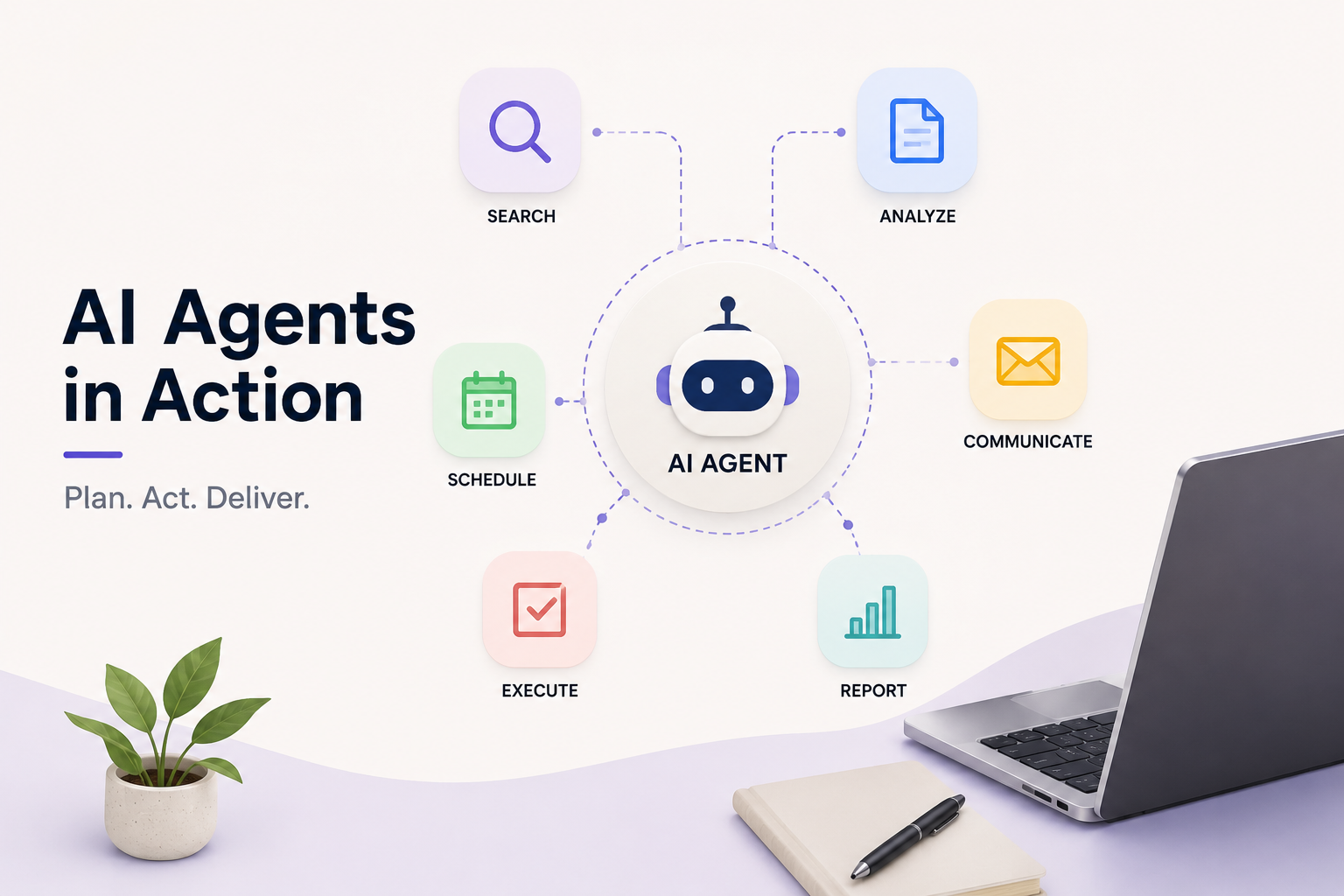
An AI agent is a system that can break a goal into steps, take actions across apps and tools on its own, and adjust when something goes wrong, instead of just answering a single prompt.
Which companies are leading the AI agent race in 2026?
Google, OpenAI, and Anthropic are among the leading companies pushing agent platforms for consumer and enterprise use, alongside strong momentum from smaller players building on shared standards such as MCP.
Are AI agents safe to use for business tasks?
AI agents are improving quickly but still need human oversight, especially for tasks involving money, credentials, or customer data, since autonomous systems can make costly mistakes or be misused if left unchecked.
How can a small business start using AI agents?
Start with a single low risk workflow, such as scheduling or first draft content, using an established platform with clear permission controls, before expanding to tasks that touch sensitive systems.