
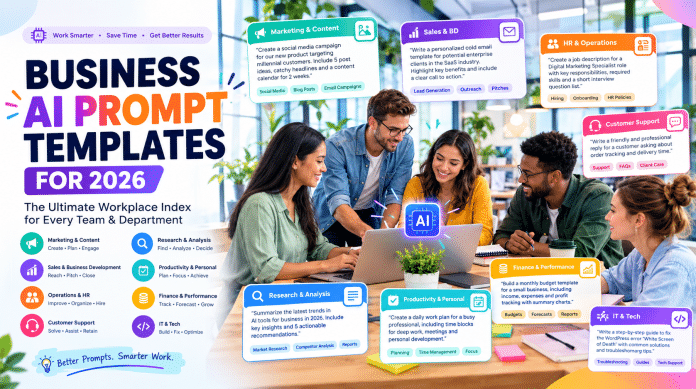
Why Every Business Needs a Prompt Library, Not Just a Few Good Prompts
Most people using AI tools at work rely on whatever prompt comes to mind in the moment, which explains why results are often inconsistent across a team. A prompt template turns a one-off attempt into a repeatable process, so a marketing assistant and a operations manager get similarly useful output from the same tool instead of wildly different results. This post collects ready-to-use business prompt templates organized by department, along with the reasoning behind why each one is structured the way it is.
If you want the underlying theory before diving into templates, our post on advanced prompt engineering techniques explains the structural elements that make a prompt effective.
Marketing and Content Prompts
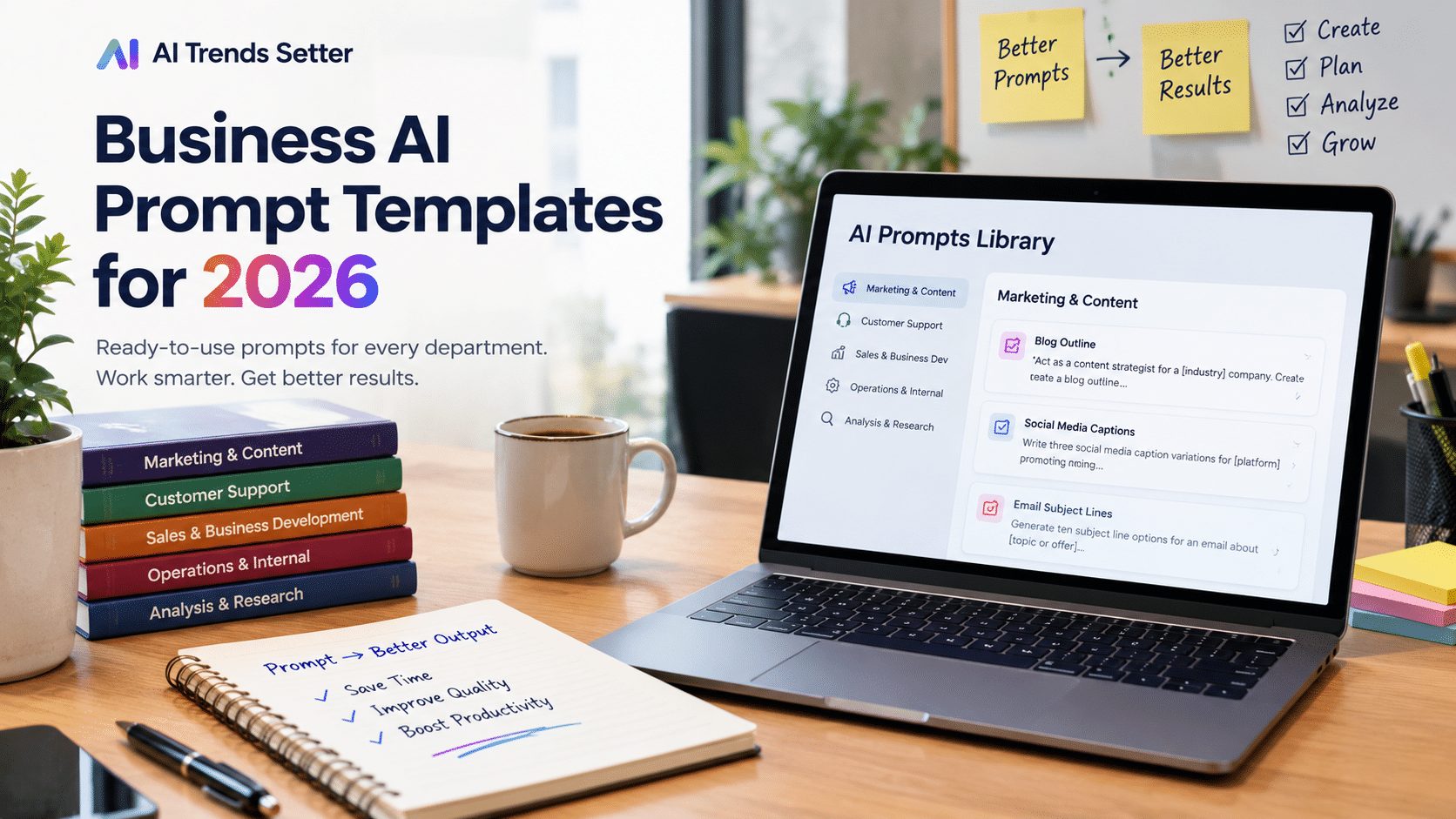
For blog outlines: “Act as a content strategist for a [industry] company. Create a blog outline for the topic [topic], targeting [audience]. Include an introduction, four to six H2 sections, and a conclusion with a call to action. Keep the tone [tone].”
For social captions: “Write three social media caption variations for [platform] promoting [product or post]. Each caption should be under [character limit], include a hook in the first line, and end with a question to drive engagement.”
For email subject lines: “Generate ten subject line options for an email about [topic or offer]. Vary the approach across curiosity, urgency, and direct benefit framing. Avoid spammy phrasing and exclamation-heavy language.”
Customer Support Prompts
For response drafting: “You are a customer support agent for [company]. A customer wrote: [paste message]. Draft a helpful, empathetic reply that addresses their concern, references our [policy name] if relevant, and offers a clear next step.”
For FAQ generation: “Based on these customer questions [paste list], generate FAQ entries with concise, accurate answers suitable for a help center page. Group related questions together.”
Sales and Business Development Prompts
For cold outreach: “Write a short, personalized outreach message to a [job title] at a [industry] company. Reference [specific detail about their business]. Keep it under 100 words, avoid generic flattery, and end with a low-friction call to action.”
For proposal summaries: “Summarize this proposal [paste content] into a one-page executive summary highlighting the problem, proposed solution, timeline, and expected outcome, written for a non-technical decision maker.”
Operations and Internal Communication Prompts
For meeting summaries: “Summarize the following meeting notes into key decisions made, action items with owners, and open questions still needing resolution: [paste notes].”
For process documentation: “Turn this rough description of our process [paste description] into a clear, numbered standard operating procedure suitable for onboarding a new team member.”
Analysis and Research Prompts
For competitor analysis: “Analyze these notes on [competitor name] [paste notes] and summarize their apparent strengths, weaknesses, and positioning compared to our own offering in [category].”
For data summaries: “Summarize the key trends in this data [paste data or description] in plain language for a non-technical audience, highlighting the three most important findings.”
Why These Templates Work Better Than Freeform Prompts
Every template above follows the same structure: define a role, provide specific context, and state a clear output format. This structure removes ambiguity, which is the main reason freeform prompts produce inconsistent results. When a prompt tells the model exactly who it should act as and what format the answer needs to take, the output requires far less editing before it is usable. This is the same principle covered in more depth in our guide on what generative AI is and how it works.
Customizing Templates for Your Business
Treat these templates as starting points, not fixed scripts. Replace the bracketed placeholders with real specifics, and over time, save the versions that consistently produce good results in a shared document your team can reuse. Businesses that build this kind of internal prompt library see faster onboarding for new hires using AI tools, since new team members can start from a proven template instead of guessing at phrasing.
Common Prompt Mistakes to Avoid
The most common mistake is being too vague about the desired output format, leading to responses that need heavy restructuring before use. A second common mistake is not providing enough context about the business or audience, which produces generic output that could apply to any company. Finally, many users skip iterating, accepting the first response instead of asking the AI to revise tone, length, or focus, even though a quick follow-up prompt often gets much closer to what is actually needed.
Building a Shared Prompt Library for Your Team
Once a few templates prove reliable, store them somewhere the whole team can access, whether that is a shared document, a wiki page, or a dedicated prompt management tool. Tag templates by department and use case so people can find the right one quickly, and assign someone to own updates as tools and business needs change. This turns prompt engineering from an individual skill into an organizational asset, which is where the real time savings compound across a growing team.
Frequently Asked Questions
What makes a good business AI prompt?
A good prompt defines a role for the AI, provides specific context about the task, and states the exact format the output should take, rather than leaving those details open to interpretation.
Can I use the same prompt template across different AI tools?
Most well-structured prompts transfer well across major AI platforms, though minor phrasing adjustments sometimes improve results on a specific tool.
How often should a business update its prompt library?
Review and refine templates quarterly, or any time you notice a prompt consistently needs heavy editing, since that is a signal the template itself needs adjustment.
Do prompt templates work for non-marketing tasks too?
Yes, the same structured approach applies to operations, sales, support, and analysis tasks, not just content creation.
Should every employee write their own prompts?
A hybrid approach works best. Individuals can adapt shared templates for their specific task, but starting from a tested template avoids the inconsistency that comes from everyone writing prompts from scratch.