
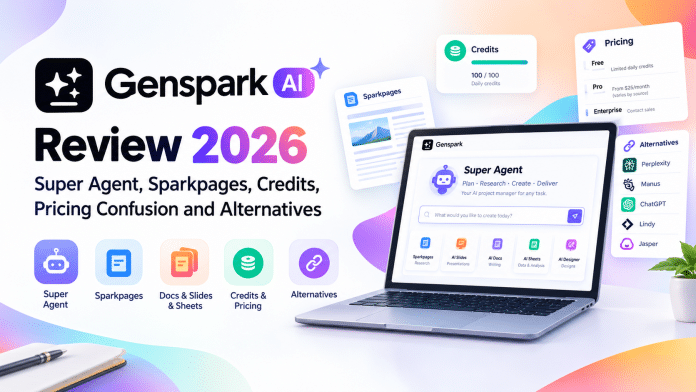
“Genspark AI” gets about 33,000 monthly searches in the United States according to keyword data pulled this week, and the keyword is considered fairly easy to rank for. Yet many people searching it still ask the same basic questions: what is Genspark, how does it differ from ChatGPT, and what does it really cost?
This review answers those questions using what independent reviewers have published, and it flags the places where sources disagree, especially on pricing.
What is Genspark AI?
Genspark is an AI company founded in 2024 in Palo Alto, California. According to one 2026 review, it launched in June 2024 as an AI search engine and then pivoted in April 2025 into what it is best known for today: an agentic AI workspace built around a Super Agent.
One small warning for anyone researching it: search results often mix Genspark AI with GenSpark, an unrelated coding bootcamp. Make sure you are reading about the AI product.
How Genspark works: Super Agent and Sparkpages
Two features define the experience.
Super Agent
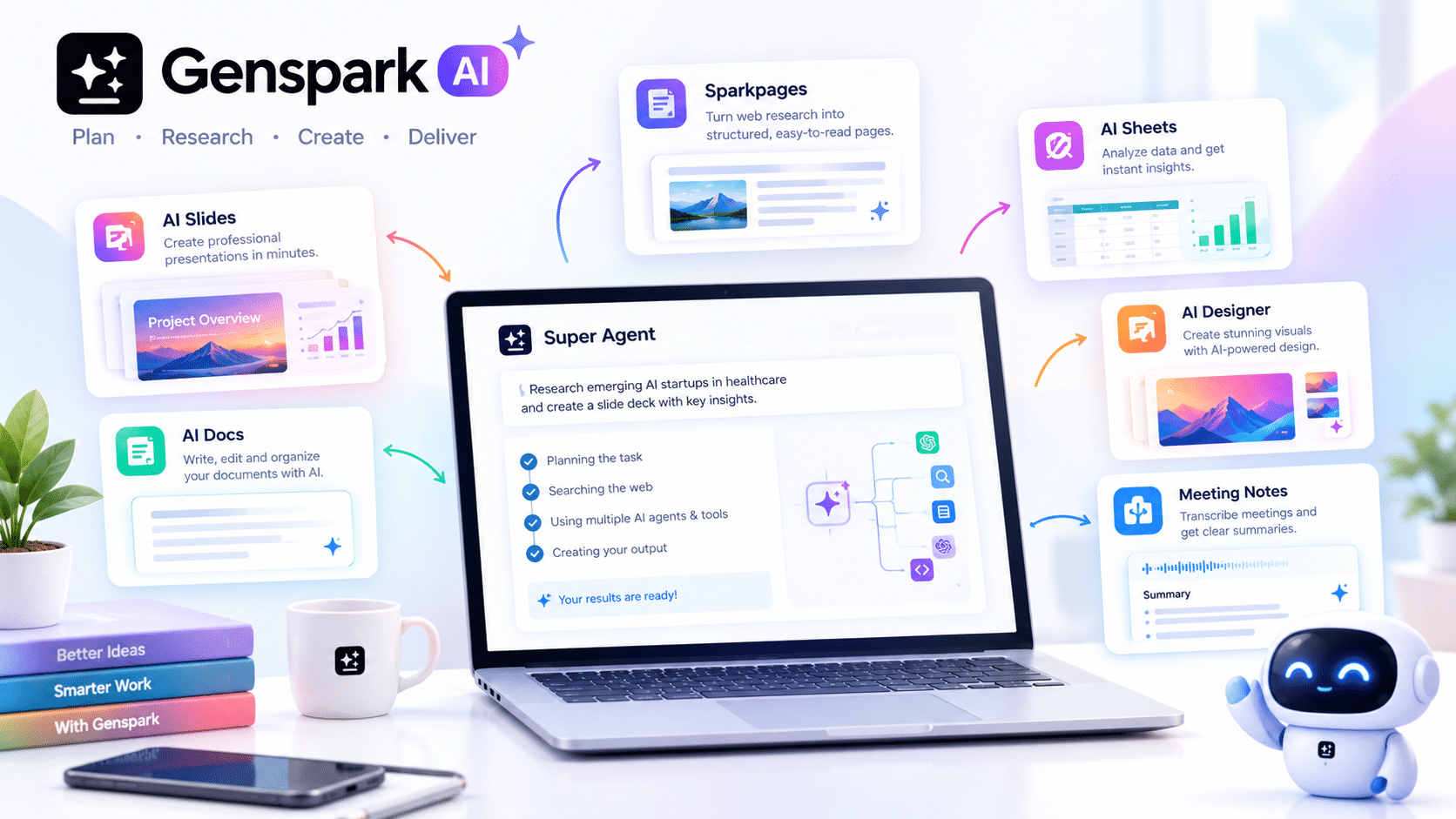
Super Agent is the core of the product. You give it a multi-step request, and it plans the work, splits it into smaller jobs, coordinates multiple AI models and tools, and combines the results into one output. Reviewers describe it as acting like a project manager for AI tasks. One description says it can coordinate more than 80 tools. For example, you could ask it to research emerging AI startups in a sector, and it would divide the research across its agents and compile a result.
Sparkpages
Sparkpages are the structured pages Genspark builds when it synthesizes web research. Instead of a list of links, you get a single organized page with the findings. Reviewers consistently describe this as one of the product’s strongest features for quick synthesis.
Task agents: slides, docs, sheets and more
Beyond research, the workspace offers dedicated agents such as AI Slides, AI Docs, AI Sheets and AI Designer, plus an AI Meeting Notes agent that transcribes meetings and shares summaries. The slide agent is often highlighted because it handles the outline, content and design sequence in one go, where many tools make you iterate through each step.
Genspark pricing: what we can and cannot verify
This is where honesty matters. Genspark uses a credit based system, and one reviewer notes that the live pricing page is behind a login, which is why many user reviews describe the pricing as unclear.
What sources broadly agree on:
- There is a free tier with a limited number of daily credits. One review puts it at around 100 credits a day, enough to try Super Agent and Sparkpages.
- There are paid tiers above it, and enterprise pricing is handled through sales.
- Different tasks consume different amounts of credit, and a full AI slide deck is listed as one of the heavier jobs.
What sources do not agree on is the exact price of paid plans. One directory lists paid plans from about $25 a month, while another review describes a higher tier at $39.99 billed annually or $49.99 billed monthly. Prices and plan names change, and availability can vary by location, so check the plan screen inside your account before you pay.
What users like
- Breadth. One product covers research, slides, spreadsheets, documents and more.
- Speed of first drafts. Sparkpages and the slide agent get you to a usable draft quickly.
- Entry cost. Some users compare it to Manus and describe it as noticeably cheaper for similar work, though that is an opinion, not a measured result.
Where Genspark falls short
- Credits can run out quickly, and heavy tasks use more of them, which frustrates paying customers.
- Support gaps are a recurring complaint in reviews.
- It is not built for developers. If you need to integrate AI search or task automation into your own application, one review states Genspark cannot do that.
- Pricing transparency is weak because plan details sit behind an account.
Genspark alternatives in 2026
Reviewers most often compare Genspark with these tools. Prices below are as reported in a 2026 review and may have changed.
| Tool | Reported pricing | Where it differs |
|---|---|---|
| Perplexity | Free tier, Pro $20 per month, Max $200 per month | Stronger as a research and answer engine, less polished for multi-step task automation |
| Manus | Free tier with 300 daily credits, Standard $20 per month, Extended $200 per month | Often cited as stronger on hard, exploratory technical tasks, with usage based costs |
| ChatGPT | Free tier and paid plans | A general assistant rather than a workspace of specialized agents |
| Lindy and Jasper | Credit based and per seat respectively | Closer to workflow automation and marketing content |
Who should use Genspark?
Genspark fits people who want one workspace for research summaries, presentations and documents and who are comfortable managing credits. It is a good test for freelancers, marketers and students who build slide decks and reports often. It is a weaker fit if you need predictable monthly costs, developer integrations or guaranteed support response times.
A sensible way to start is the free tier. Run one real task you do every week, such as a research brief or a short deck, note how many credits it used, and then decide if a paid plan makes sense.
Frequently asked questions
What is Genspark AI?
Genspark is an AI workspace built around a Super Agent that plans and runs multi-step tasks, along with Sparkpages for research and agents for slides, docs and sheets.
Is Genspark free?
There is a free tier with a limited number of daily credits. Heavier tasks use more credits, so free use is mainly for testing.
How much does Genspark cost?
Sources disagree. Some list paid plans from around $25 a month and others describe higher tiers near $40 to $50 a month. Check the plan page inside your account for the current price.
What is a Sparkpage?
A Sparkpage is a structured page Genspark creates from web research, giving you an organized summary instead of a list of links.
What are the best Genspark alternatives?
Perplexity and Manus are the most common comparisons, with Perplexity stronger for research answers and Manus often cited for deeper technical tasks.