
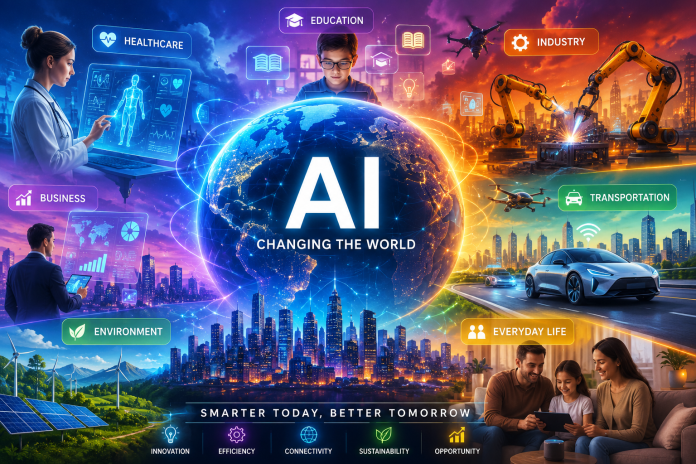
Artificial Intelligence is no longer an emerging technology, it’s a driving force reshaping how businesses operate, how people work, and how societies function. In 2026, AI’s influence extends far beyond tech companies, touching healthcare, education, finance, transportation, and nearly every other sector imaginable.
This article explores the tangible ways AI is transforming the world today, the industries experiencing the biggest shifts, and what this means for the future.
The Acceleration of AI Adoption
Just a few years ago, AI was largely confined to research labs and specialized tech applications. Today, generative AI tools, automation platforms, and intelligent systems are embedded in everyday business operations and consumer products.
This rapid adoption has been driven by several factors:
- Improved accessibility: AI tools are now user-friendly, requiring little to no technical expertise.
- Lower costs: Cloud-based AI services have made advanced capabilities affordable for businesses of all sizes.
- Proven ROI: Companies adopting AI are seeing measurable improvements in efficiency, cost savings, and revenue growth.
- Competitive pressure: Businesses that don’t adopt AI risk falling behind competitors who do.
As a result, AI has shifted from a “nice-to-have” innovation to a core component of modern business strategy.

Industries Being Transformed by AI
Education
AI is enabling personalized learning experiences by adapting content to individual student needs. Intelligent tutoring systems can identify where a student is struggling and adjust lesson plans accordingly. Educators also use AI tools to automate administrative tasks, freeing up more time for actual teaching.
Retail and E-commerce
AI-driven recommendation engines have become standard in online shopping, personalizing product suggestions based on browsing and purchase history. Inventory management systems use AI to predict demand, reducing waste and improving supply chain efficiency. Customer service chatbots also handle a significant portion of routine inquiries, improving response times.
Finance
Financial institutions use AI for fraud detection, risk assessment, and algorithmic trading. AI systems can analyze transaction patterns in real time, flagging suspicious activity far faster than manual review processes. Additionally, AI-powered financial advisory tools help individuals make more informed investment decisions based on personalized data analysis.
Manufacturing
AI-powered predictive maintenance helps manufacturers identify equipment issues before they cause costly breakdowns. Robotics combined with AI enable more precise, efficient production lines, while quality control systems use computer vision to detect defects faster than manual inspection.
Marketing and Content Creation
Generative AI tools have transformed how businesses create content, from writing copy to generating images and video. Marketing teams use AI to analyze consumer behavior, personalize campaigns, and optimize ad spending with far greater precision than traditional methods allowed.
Healthcare
AI is revolutionizing healthcare through improved diagnostics, personalized treatment plans, and administrative efficiency. Machine learning models can analyze medical images to detect conditions like cancer earlier and more accurately than traditional methods in many cases. AI-powered chatbots also help patients schedule appointments, answer basic health questions, and manage routine communication with healthcare providers.

The Impact on Jobs and the Workforce
One of the most discussed aspects of AI’s growth is its effect on employment. While concerns about job displacement are valid, the reality is more nuanced than “AI replacing jobs.”
Tasks Being Automated
AI is primarily automating repetitive, data-heavy tasks such as data entry, basic customer service inquiries, and routine content generation. This allows human workers to focus on more strategic, creative, and interpersonal aspects of their roles.
New Job Roles Emerging
As AI adoption grows, new roles are emerging around AI implementation, oversight, and ethics, including:
- AI trainers and prompt engineers
- AI ethics and compliance specialists
- Machine learning engineers
- AI-human collaboration specialists
The Need for Reskilling
Governments, educational institutions, and businesses are increasingly focused on reskilling workers to adapt to an AI-integrated workforce. Understanding how to work alongside AI tools is becoming a valuable skill across nearly every industry.
AI in Everyday Life
Beyond industry-specific applications, AI continues to shape daily life in subtle but significant ways:
- Smart home devices use AI to learn user preferences and automate household tasks.
- Navigation and transportation apps use AI to optimize routes and predict traffic patterns.
- Personal productivity tools use AI to summarize information, draft emails, and manage schedules.
- Entertainment platforms use AI to curate personalized content recommendations across music, video, and gaming.
These everyday applications demonstrate how deeply AI has integrated into modern life, often without users even realizing the technology behind these conveniences.
Ethical and Societal Considerations
As AI’s influence grows, so do concerns about its ethical implications. Key issues include:
- Data privacy: AI systems rely on large amounts of data, raising concerns about how personal information is collected and used.
- Bias in AI systems: AI models can inherit biases present in training data, potentially leading to unfair outcomes in areas like hiring or lending.
- Transparency: Understanding how AI systems make decisions remains a challenge, particularly with complex models.
- Regulation: Governments worldwide are developing frameworks to ensure responsible AI development and deployment.
Addressing these considerations is essential for ensuring AI’s benefits are realized responsibly and equitably across society.
What the Future Holds
Looking ahead, AI’s role in society is expected to continue expanding. Key trends shaping the future include:
- Increased personalization across products and services, powered by more sophisticated AI models.
- Greater integration of AI into physical systems, such as robotics and autonomous vehicles.
- Continued advancement in generative AI, enabling more creative and complex content generation.
- Stronger regulatory frameworks to address ethical and safety concerns as AI capabilities grow.
While predicting the exact trajectory of AI development remains challenging, one thing is clear: AI’s influence on how we live and work will only continue to deepen in the coming years.
Final Thoughts
Artificial Intelligence has moved from a futuristic concept to a present-day force reshaping industries, economies, and daily life. From healthcare and finance to education and retail, AI’s impact is both broad and deep, offering significant benefits while also raising important ethical questions.
Understanding these changes and staying informed about how AI continues to evolve is essential for individuals and businesses alike as we navigate an increasingly AI-driven world.
Frequently Asked Questions
- How is AI changing everyday life?
AI powers many everyday conveniences, including smart home devices, navigation apps, personalized entertainment recommendations, and productivity tools like email drafting assistants. - Will AI eliminate more jobs than it creates?
It’s more accurate to say AI is changing the nature of jobs rather than eliminating them entirely. While some repetitive tasks are being automated, new roles focused on AI development, oversight, and ethics are emerging. - Which industries are most impacted by AI?
Healthcare, finance, retail, manufacturing, and marketing are among the industries experiencing the most significant AI-driven transformation. - What are the biggest ethical concerns with AI?
Key concerns include data privacy, algorithmic bias, lack of transparency in decision-making, and the need for effective regulation. - How can businesses prepare for continued AI growth?
Businesses can prepare by investing in AI literacy for employees, adopting AI tools relevant to their industry, and staying informed about evolving regulations and best practices.