
Meta has entered the personal AI agent race with Muse, an assistant that does not just answer questions but takes actions for you: booking appointments, filling out forms, browsing the web and, with your approval, completing purchases. Muse launched on September 8, 2026, and it is already one of the most talked about AI products of the fall, partly because of what it can do and partly because of the privacy questions that come with handing a Meta product this much access to your digital life.
This guide covers what the Meta Muse AI agent is, what it can do, how much it costs, where it is available, how its privacy model works, and how it compares with OpenAI’s newly launched Dots agents.
What Is Meta Muse?
Muse is a personal AI agent built by Meta and led publicly by Meta’s chief AI officer, Alexandr Wang. Meta describes it as a secure, private agent that proactively helps people reach their goals, takes tasks and projects off their plate, and turns long-term goals into action plans. Unlike a standard chatbot that answers one question at a time, Muse can work through multi-step tasks and keep running in the background after you close the app.
The interface looks like a chat thread. Users can name their agent, create an avatar for it and customize how it communicates. Meta says Muse is designed to be more proactive and long-running than typical chatbots, which is the main reason it is being positioned as a step beyond assistants like Meta AI.
What Can Meta Muse Do?
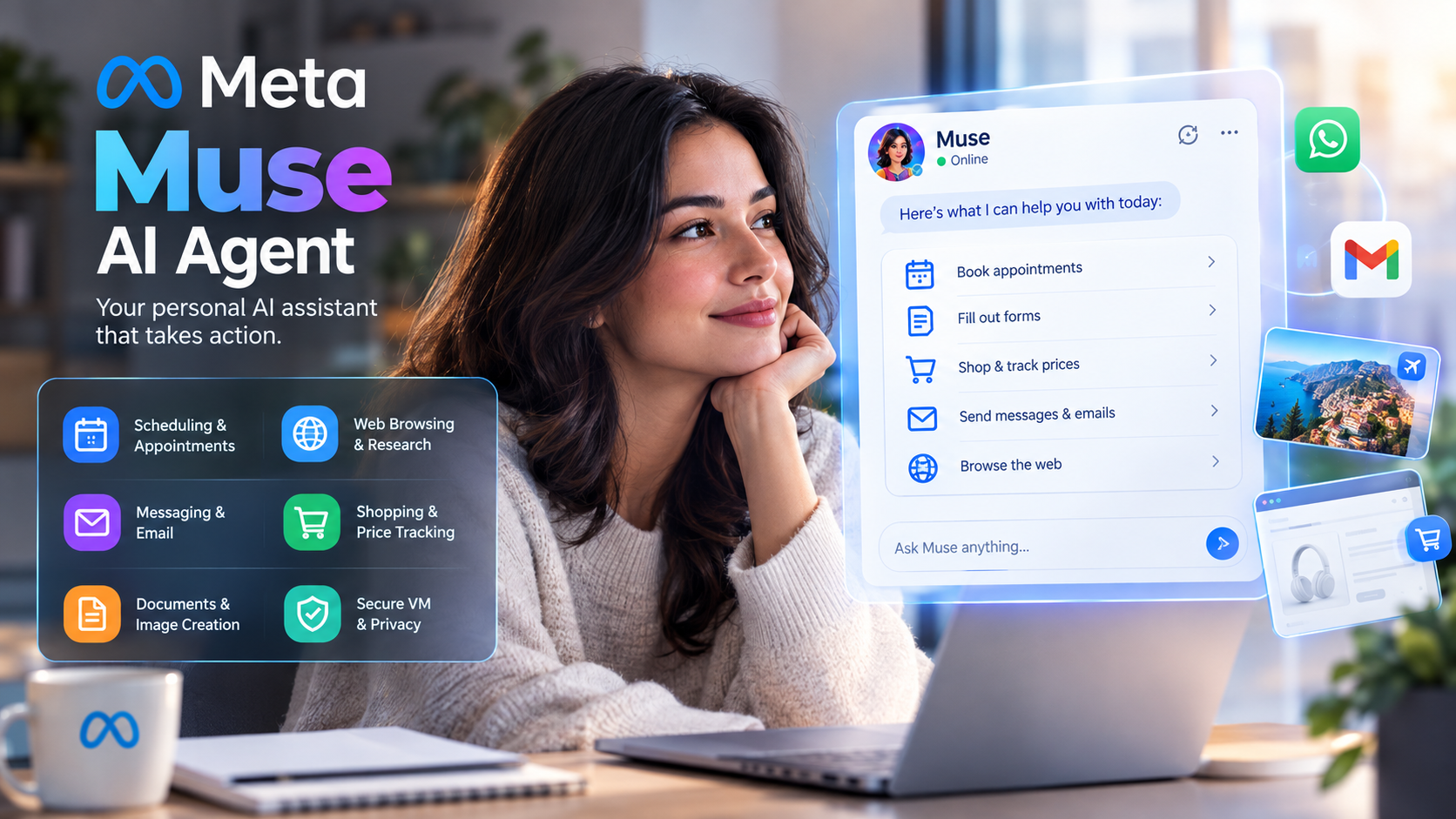
Based on Meta’s launch material and early coverage, Muse can handle everyday digital chores across the web and connected apps. The main capabilities reported so far are:
- Booking and scheduling: arranging appointments, managing reminders and helping with schedules.
- Forms and web tasks: browsing the web with a built-in browser that the user can watch, and filling out electronic forms.
- Messaging and email: sending messages and emails on your behalf once you approve them.
- Shopping: researching products, monitoring prices and completing approved purchases.
- Monitoring: Meta has mentioned uses such as watching home security camera feeds.
- Documents and images: creating documents, generating images and researching topics.
- Subagents: Muse can launch subagents for parts of a task and return to you when something changes or needs approval.
You can also reach Muse through WhatsApp, although that version does not include some of the app-only features such as the feed or the ideas tool that suggests ways to use the agent.
How Muse Works: Secure VM and the Sentinel Agent
The most distinctive part of Muse is its architecture. Meta says personal agents need a new kind of secure computer, so each Muse agent runs on its own dedicated virtual machine in Meta’s cloud, called Muse Secure VM. That machine houses both the agent and the person’s data, and it is designed to be private to each user so that no one else’s agent can reach it.
A second agent, called Sentinel, runs on the same machine but is kept separate from Muse at the system level. Its job is to check that no Muse action or output reaches the internet unless it meets certain privacy thresholds, and to ask the user for permission when needed. The idea is that an agent reading untrusted web content should not be able to control its own safeguards.
Meta also says the main Muse agent never sees your real passwords, access tokens or payment details. Credentials and permissions are handled by separate services on the host side rather than by the agent itself.
Meta Muse Price
Muse has a free tier and two paid subscription plans. According to reports on the launch, the paid plans cost $20 per month and $100 per month, with the difference depending on how heavily you use the agent. Meta says most everyday use is free and that subscriptions are meant to support heavier use. Meta has not published a detailed table of limits for each plan, so exact usage caps are not confirmed yet.
There is no advertising inside Muse at launch. Wang has said Meta is exploring commerce opportunities as a possible source of additional revenue, so that is worth watching as the product matures.
Where Is Meta Muse Available?
For now, Muse is limited to adults aged 18 and over in the United States. It is rolling out on iOS, Android and the web at https://muse.ai, and it also works inside WhatsApp. Meta has said support for its AI glasses is coming soon. There is no confirmed date for other countries, so users outside the US should treat international availability as unannounced.
Meta Muse Privacy: What Meta Says and What to Check
Privacy is the biggest question around Muse, especially because the launch came while Meta was already under public pressure over privacy and safety. These are the key points Meta has made:
- Muse runs in an isolated environment and does not see your actual passwords or payment details.
- For checkout, Meta says Stripe Link can provide a one-time-use card with purchase protections on eligible transactions. Support for Shop Pay and 1Password is planned rather than live at launch.
- You can choose to allow an action once, always allow it, or deny it, and you can change the default permission for each connected service at any time.
- Meta uses interactions to improve its models unless you opt out. If you do not opt out, Meta says it removes critical personally identifying information first.
It is important to treat these as company claims. Meta’s own launch material notes that security and capability statements come from Meta, and independent reviewers have pointed out that protections such as limits on employee access rely on operational policy rather than guarantees that Meta cannot technically reach the data. Muse is also new, so integrations and safeguards may change.
If you try it, a sensible approach is to start with low-risk tasks, keep permissions on “allow once” for anything involving money or messages, and review the training opt-out setting before you share personal information.
Meta Muse vs OpenAI Dots
Muse is not the only always-available agent launching right now. OpenAI introduced its Dots agents at its developer event on September 29, 2026. You can read the details in our guide to OpenAI Dots price, availability, features and limits.
| Feature | Meta Muse | OpenAI Dots |
|---|---|---|
| Launch date | September 8, 2026 | September 29, 2026 |
| How you use it | App on iOS and Android, web, WhatsApp | Calling or texting your agent |
| Agents per person | One personal agent you can name and customize | One agent per person for now |
| Model | Not verified for the consumer agent | GPT-6 Astra |
| Pricing | Free tier, plus $20 and $100 monthly plans | See our Dots guide |
| Availability | US only at launch, 18 and over | See our Dots guide |
The practical difference is the entry point. Muse is a full app with a feed, avatars and a visible browser, while Dots leans on a more conversational, phone-style experience. Both reflect the same shift: AI companies are moving from chatbots toward agents that act on your behalf. If you are weighing agents for work rather than personal use, our guide to getting Siri AI on iPhone with iOS 27 covers another major assistant upgrade arriving this season.
Who Should Try Meta Muse?
Muse makes the most sense for people in the US who want to hand off routine personal tasks such as booking, form filling and price monitoring, and who are comfortable with Meta’s data practices. Because the free tier covers most everyday use, trying it carries little financial risk. People who handle sensitive information, or who simply do not trust Meta with their personal data, may prefer to wait for independent security reviews before connecting email, calendars or payment tools.
For more detail straight from the source, see Meta’s official Muse announcement and the Muse product page.
Frequently Asked Questions
What is Meta Muse?
Meta Muse is a personal AI agent from Meta that can browse the web, use connected apps, fill out forms, send approved messages and complete approved purchases for you.
How much does Meta Muse cost?
Muse has a free tier and paid plans reported at $20 and $100 per month, depending on usage. Meta has not published a full breakdown of limits for each plan.
Is Meta Muse available outside the United States?
Not yet. Muse launched in the US for adults aged 18 and over. Meta has not announced dates for other countries.
Is Meta Muse safe and private?
Meta says Muse runs on an isolated virtual machine, uses a separate Sentinel agent to check outgoing actions, and never sees your real passwords or payment details. These are Meta’s claims, and you can opt out of having your interactions used for model training.
Can Meta Muse make purchases?
Yes, with your approval. Meta says Muse can check out using Stripe Link, which can provide a one-time-use card with purchase protections on eligible transactions.
Final Thoughts
Meta Muse is a serious attempt to make a personal AI agent mainstream, with a free tier, wide platform support and an unusually detailed security design. Whether it earns long-term trust will depend on how well the privacy promises hold up under independent testing and how Meta handles data and commerce as the product grows. For now, it is worth trying with low-risk tasks and keeping tight control over permissions.