
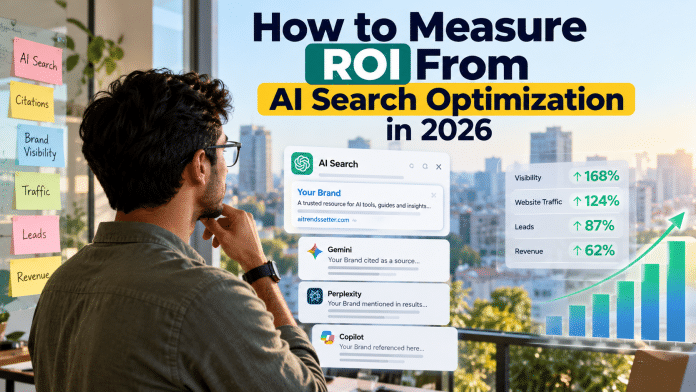
What AI Search Optimization Actually Means in 2026
AI search optimization, sometimes called generative engine optimization, is the practice of getting your content cited and referenced inside AI-generated answers, not just ranked in a traditional list of blue links. As more searches get answered directly by AI overviews and chat-based search tools, businesses are spending real budget on this, but many struggle to answer a basic question: how do you actually measure the return on that spend? This post walks through a practical framework for tracking AI search optimization ROI, since guessing is not a strategy that scales.

If you have not read our foundational post on how to measure and maximize AI ROI, start there for the general principles this post builds on.
Why AI Search ROI Is Harder to Track Than Traditional SEO
Traditional SEO has a fairly clean funnel: a keyword ranks, a user clicks, that click is trackable in analytics. AI search optimization breaks that model, because a citation inside an AI-generated answer often does not produce a click at all. A user might get their answer directly from the AI overview and never visit your site, even though your content was the source. This is often called a zero-click outcome, and it means brand visibility and trust can increase even while direct traffic from that specific query stays flat or drops.
Step 1: Establish a Citation Tracking Baseline
Before measuring improvement, you need to know your starting point. Manually query major AI search tools with your target questions and record whether your brand or content is cited, and if so, how prominently. This is tedious to do by hand at scale, which is why several tools launched in the past year specifically to automate AI citation tracking, similar to how rank tracking tools work for traditional search.
Step 2: Track Brand Mention Volume, Not Just Clicks
Since direct clicks undercount the real impact of AI search visibility, track brand mention volume as a supporting metric. This includes direct traffic increases, branded search volume growth in Google Search Console, and any qualitative feedback like customers mentioning they found you through an AI assistant. None of these are perfect proxies alone, but together they paint a clearer picture than click data by itself.
Step 3: Measure Content Structure Improvements Against Citation Rate
One of the more reliable ways to prove ROI is a before-and-after test: restructure a page with clearer headers, FAQ sections, and direct answers near the top, then track whether citation frequency for related queries improves over the following weeks. This isolates the impact of your optimization work from broader market noise, giving you a defensible number to report internally.
Step 4: Connect AI Visibility to Downstream Business Metrics
The ultimate ROI question is whether AI search visibility contributes to leads, signups, or sales, not just visibility for its own sake. Add a simple attribution question to signup or contact forms asking how someone found you, and track how often “AI assistant” or similar answers appear over time. This is a low-cost way to connect a hard-to-track channel to revenue without needing enterprise-level attribution software.

What a Realistic ROI Timeline Looks Like
AI search optimization tends to move slower than traditional content marketing in terms of visible payoff, since AI models update their training and retrieval sources on their own schedules rather than reindexing daily like traditional search. Most businesses should expect a three to six month window before citation improvements become measurable and consistent, similar to the patience required for traditional SEO gains. Budgeting and reporting expectations should be set accordingly, so early results are not mistaken for failure.
Common Mistakes When Evaluating AI Search ROI
The biggest mistake is judging AI search optimization purely by direct traffic, which misses most of its actual value given the zero-click nature of many AI-generated answers. A second mistake is optimizing content only for AI citation while ignoring readability for human visitors who do click through, which can hurt conversion even as visibility improves. The strongest approach treats AI search optimization as additive to solid fundamentals, not a replacement for them, an approach we cover in our post on measuring the ROI of AI investments more broadly.
Building a Simple Reporting Dashboard
You do not need enterprise software to report on this internally. A simple spreadsheet tracking citation status for your top ten target queries, branded search volume month over month, and any attribution survey data is enough for most small and mid-sized businesses to demonstrate trend direction to stakeholders. Update it monthly, and pair the numbers with a few concrete examples of citations you have found, since screenshots of your brand appearing in an AI answer are often more persuasive to decision makers than a chart alone.
Who Should Own AI Search Optimization Internally
For most small and mid-sized businesses, this work fits naturally within the existing SEO or content function rather than requiring a separate hire, since the underlying skills of structuring content clearly and tracking performance over time carry over directly. What does change is the reporting cadence and the metrics being tracked, so make sure whoever owns this work has buy-in from leadership on a realistic timeline before results start rolling in.
Frequently Asked Questions
How do I measure ROI from AI search optimization efforts?
Combine citation tracking across major AI search tools, branded search volume trends, and a simple attribution question on lead forms to connect visibility to actual business outcomes, since direct click tracking alone significantly undercounts the impact.
Does AI search optimization replace traditional SEO?
No, it works alongside traditional SEO. Strong on-page fundamentals, clear structure, and authoritative content remain the foundation that both traditional rankings and AI citations are built on.
How long does it take to see results from AI search optimization?
Most businesses should expect a three to six month timeline before citation improvements become measurable and consistent, similar to typical SEO timelines.
What tools can track AI search citations?
A growing category of AI visibility and citation tracking tools launched over the past year specifically for this purpose, alongside manual query testing across major AI search platforms.
For the general formula and a worked example you can adapt to any AI project, see how to measure AI ROI.