
The Short Answer
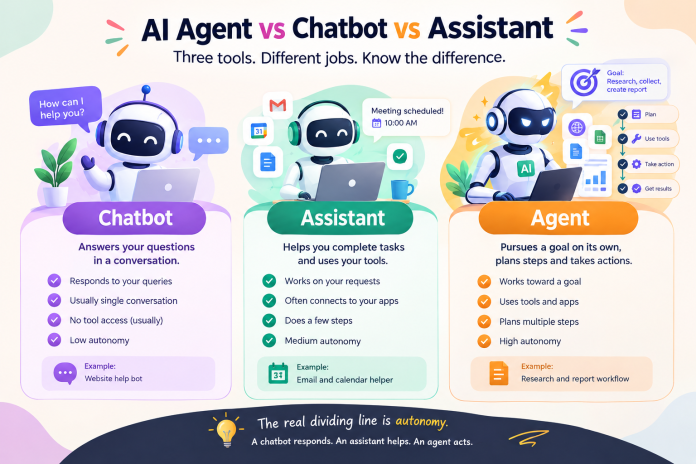
- Chatbot: talks with you and answers questions, usually within one conversation.
- AI assistant: helps you complete tasks, often with access to your tools and data, but waits for your instructions.
- AI agent: pursues a goal on its own, plans steps, uses tools and takes actions with limited supervision.
The real dividing line is autonomy. A chatbot responds. An assistant helps. An agent acts.
What Is an AI Chatbot?
A chatbot is a program that holds a conversation. Older chatbots followed fixed scripts and could answer only a narrow set of questions, like a store hours bot on a website. Modern chatbots built on large language models can discuss almost any topic and write in natural language. Even so, the classic chatbot job is still to answer. It does not usually go away and do things on your behalf.
Good uses include customer support answers, learning a topic, drafting text, brainstorming ideas and explaining code. The limits are that it only knows what is in the conversation and its training, and it does not carry out multi-step tasks unless you guide each step.
What Is an AI Assistant?
An AI assistant goes a step further. It is designed to help you get work done, and it often connects to your calendar, email, documents or business tools. You tell it what you want, and it does that task: summarize this thread, draft a reply, schedule a meeting, find the file about last quarter.
The key trait is that you stay in control. The assistant waits for a request, performs it and shows you the result. It may take a few actions, but it does not decide your goals.
What Is an AI Agent?
An AI agent is given a goal, and it works out how to reach it. It can break the goal into steps, decide which tools to use, take actions, check the results and adjust. For example, you might ask an agent to research five competitors, collect their pricing into a spreadsheet and prepare a summary. It may browse websites, read documents, write the file and fix its own mistakes along the way.
Agents are more capable and more risky. Because they act with less supervision, a wrong decision can have real consequences, such as sending an email to the wrong person or changing a record. That is why permissions and approvals matter far more for agents than for chatbots.
AI Agents vs Chatbots vs Assistants: Comparison Table
| Feature | Chatbot | AI assistant | AI agent |
|---|---|---|---|
| Main job | Answer questions | Help complete tasks | Achieve a goal |
| Autonomy | Low | Medium | High |
| Uses tools and apps | Rarely | Often | Almost always |
| Plans multiple steps | No, you guide it | Some | Yes |
| Needs your input | Every step | Each request | Mostly at the start and for approvals |
| Risk level | Low | Medium | Higher |
| Typical example | Website help bot | Email and calendar helper | Research and report workflow |
Where the Lines Blur
Marketing makes this harder. Many products labeled agent are really assistants with a few automated steps, and many chatbots now include assistant features. A useful test is to ask three questions. Does it take actions outside the chat? Does it decide the steps on its own? Can it keep working without you? The more times you answer yes, the more agent-like the tool is.
Recent launches show how fast the category is moving. We covered always-on agents in our guide to OpenAI Dots and personal agents with a privacy angle in our guide to Meta Muse.
Which One Should You Use?
Choose a chatbot when
- You need quick answers, explanations or writing help.
- The task is small and fits in one conversation.
- You do not want to connect any accounts.
Choose an assistant when
- You want help with daily work in email, documents or calendars.
- You want to review each result before anything happens.
- Your tasks are repeated but need human judgment.
Choose an agent when
- The job has many steps and follows a clear pattern.
- The cost of a mistake is low, or you can set approvals for risky steps.
- You can define what success looks like.
Real Examples for Small Businesses
A local store can use a chatbot to answer questions about hours and returns. The owner can use an assistant to summarize customer emails and draft replies. A growing online shop might use an agent to monitor stock levels, compare supplier prices and prepare purchase orders for approval. Each step up adds value, and each step up needs more care.
Safety Rules for Agents
- Give the minimum access needed, and prefer read-only permissions at first.
- Require approval for actions that send messages, spend money or delete data.
- Keep logs so you can see what the agent did and why.
- Test on low-risk tasks before you trust it with important ones.
- Watch for prompt injection, where content from a web page or email tries to trick the agent into doing something unwanted.
- Review results regularly, because agents can sound confident while being wrong.
Cost and Setup Differences
Chatbots are often free or low cost and take minutes to start. Assistants usually need account connections and may cost more because they use your data and tools. Agents can be the most expensive because they run many steps and use more computing. Always check how usage is billed, whether by seat, by credits or by task, so a long-running agent does not surprise you with a large bill.
Final Verdict
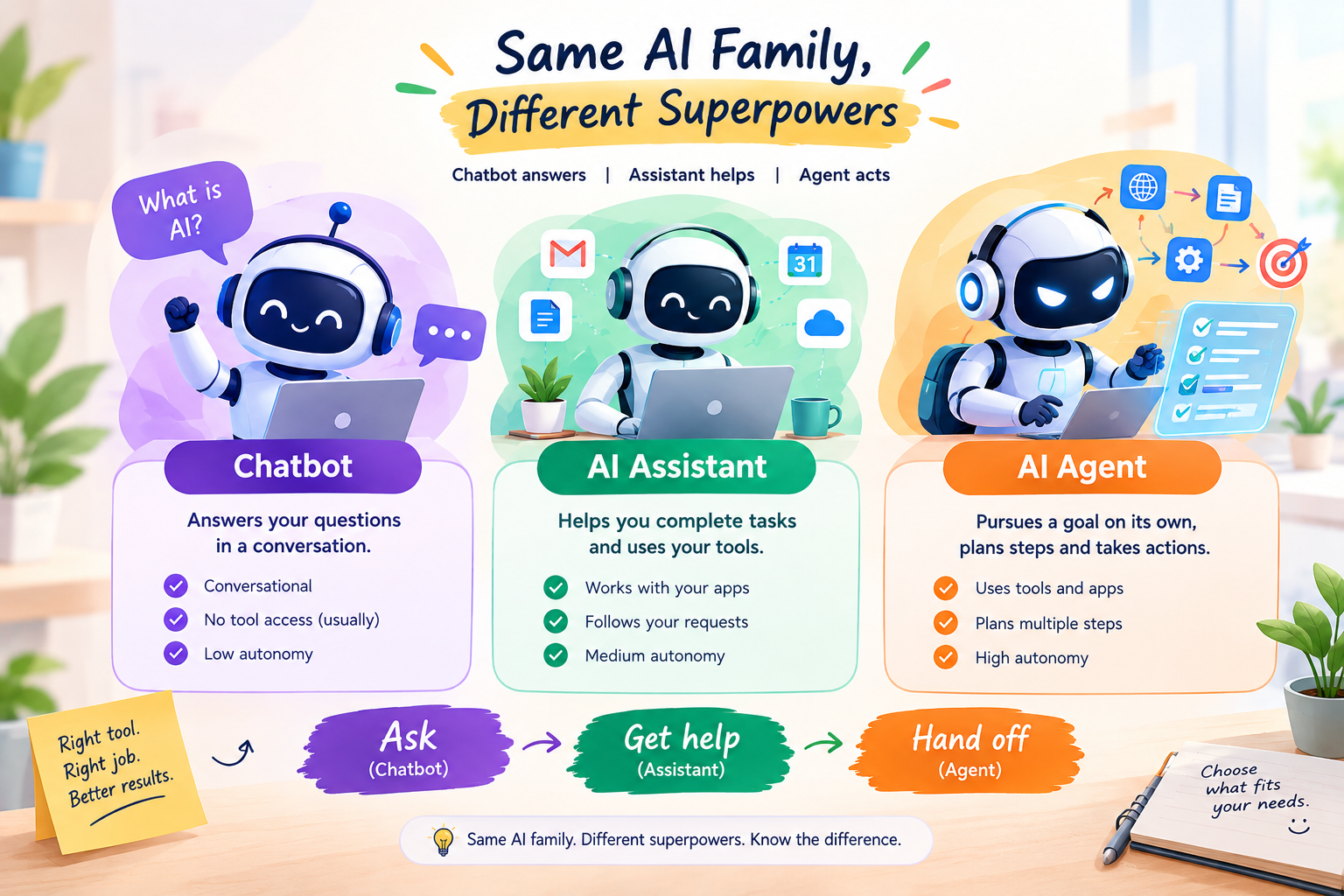
Use a chatbot to ask, an assistant to get help and an agent to hand off a defined job. Start with the simplest tool that solves your problem, and only move to agents when you have clear goals, safe permissions and a way to review the work. The more freedom you give an AI, the more important it is to control what it can touch.
Frequently Asked Questions
What is the main difference between an AI agent and a chatbot?
A chatbot answers questions within a conversation, while an AI agent pursues a goal by planning steps, using tools and taking actions with limited supervision.
Is an AI assistant the same as an AI agent?
No. An assistant helps with tasks you request and waits for your instructions, while an agent can decide the steps on its own and keep working toward a goal.
Are AI agents safe to use?
They can be, if you limit permissions, require approval for risky actions, keep logs and start with low-risk tasks. Agents carry more risk than chatbots because they act with less supervision.
Do I need an AI agent for my small business?
Not always. A chatbot or assistant may be enough. Consider an agent when you have a repeatable multi-step process with clear success criteria and safe approval points.
Can a chatbot become an AI agent?
Yes. When a chatbot is given tools, memory and the ability to plan and act toward a goal, it starts to behave like an agent.
—