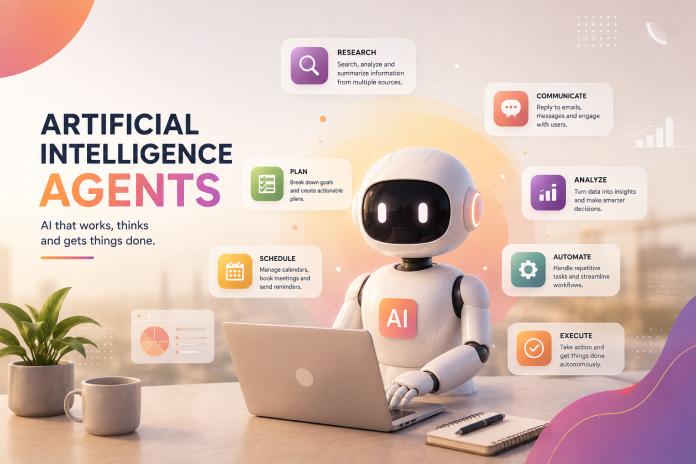
“Agent” has become the most overused word in AI marketing this year. Every chatbot got rebranded as an agent, every workflow tool added “agentic” to its homepage, and the gap between what gets marketed as an AI agent and what actually works has never been wider. So let’s cut through that and answer the question properly: what is an AI agent, how is it different from the ChatGPT-style tools you already use, and does it actually matter for your work in 2026?
What Is an AI Agent?
An AI agent is a system built on a large language model that can take a goal, break it into smaller steps, use tools or APIs to carry out those steps, and keep working until the goal is reached, all with limited human supervision at each step.
That last part is the key difference from a regular chatbot. When you ask ChatGPT or Claude a question, it thinks, responds, and stops. It’s reactive. An AI agent is designed to be proactive. Give it a goal like “research three competitor pricing pages and summarise the differences,” and instead of just replying with an answer from its training data, it goes and does the research: it browses, reads, extracts data, and delivers a finished result.
If you’ve read our guide on what AI automation actually means, you already understand the parent concept. Agentic AI is the next layer on top of automation: instead of following a fixed, pre-programmed workflow, an agent decides its own steps to reach a goal, and adjusts if something doesn’t work the first time.
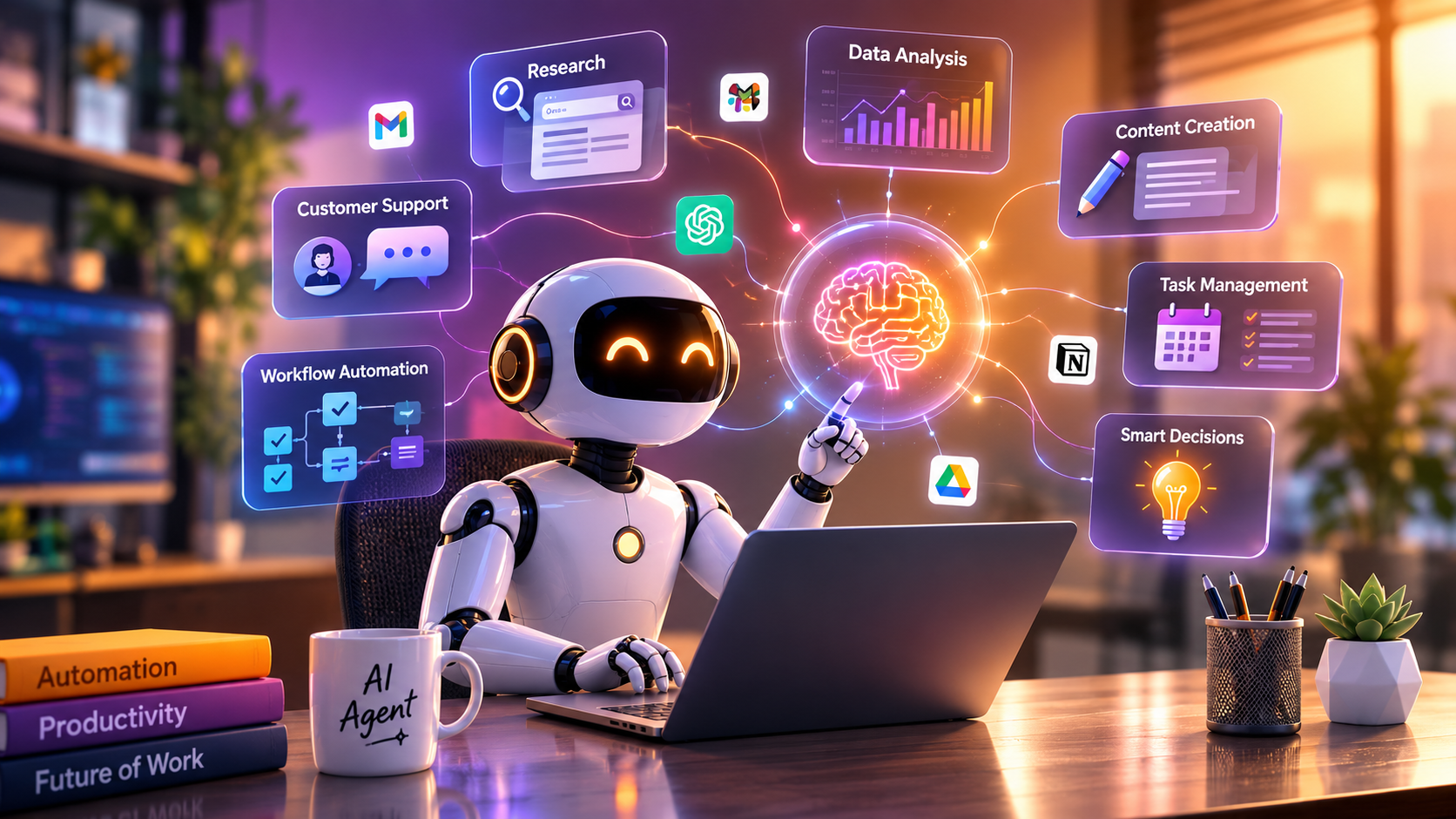
How AI Agents Actually Work
Every functioning AI agent, regardless of what it’s built for, relies on the same basic loop:
Perceive → Plan → Act → Observe → Adapt
Perception
The agent takes in information from its environment. That could be a user’s instruction, data from a database, the contents of a webpage, or the output of a previous tool call.
Planning
The underlying language model reasons about the goal and breaks it into a sequence of smaller tasks. This is where most of the “intelligence” shows up, since the agent has to decide what order to do things in and what could go wrong.
Action
The agent calls external tools, APIs, or applications to actually do something. This might mean running code, searching the web, sending an email, updating a spreadsheet, or querying a company database.
Observation and Adaptation
After each action, the agent checks the result. If the plan isn’t working, a well-built agent revises its approach rather than repeating the same failed step.
This loop is what separates an agent from a simple automation script. A traditional automation follows the same fixed path every time. An agent can change its plan mid-task based on what it learns along the way.
Where AI Agents Are Actually Working in 2026
There’s a lot of hype in this space, so it’s worth being specific about where agents are genuinely production-ready this year versus where they’re still experimental.
Customer Support
Agents that read a ticket, pull relevant account data, resolve routine issues, and only escalate genuinely complex cases to a human are now common in mid-size and large support teams.
Software Development
Coding agents that can plan a multi-step change, write the code, run tests, and fix their own mistakes without constant hand-holding have become one of the most mature agent categories. This is one of the reasons coding is often the first place businesses see real ROI from agentic tools.
Sales Outreach
Agents that research a lead, personalise an email, and manage follow-up sequences are being used to handle the repetitive parts of prospecting.
Operations and Back-Office Work
Agents connected to CRMs, ERPs, and internal databases are handling data entry, report generation, and routine approvals.
Where Agents Are Still Shaky
Long-running tasks that need to operate for hours without any human review, and regulated environments with strict audit requirements. If a vendor claims their agent can run completely unsupervised in a compliance-heavy workflow, that’s worth double-checking before you trust it with anything important.
AI Agents vs Chatbots vs Automation: What’s the Real Difference?
A chatbot answers questions. It’s reactive, stateless in most cases, and stops the moment it delivers a response.
Automation follows a fixed set of rules you define in advance. It’s reliable and predictable, but it can’t handle anything outside the script you wrote.
An AI agent sits between the two, closer to automation in that it takes real action, but closer to a chatbot in that it uses reasoning to decide what to do next rather than following a rigid, pre-set path.
If you’re trying to decide whether your business needs full automation or an agent, the honest answer in 2026 is usually both. Most real-world systems combine fixed automation for the predictable, repetitive parts of a process with an agent layered on top to handle the parts that need judgment. We cover this distinction in more depth in our piece on whether AI automation will replace jobs, which is worth a read if you’re thinking about where agents fit into your own workflow.
Should Your Business Actually Use AI Agents Right Now?
The honest answer depends on the task, not the hype. Agents earn their keep fastest on high-volume, well-defined tasks: first-line customer support, lead research, routine reporting, and repetitive coding tasks. They’re a poor fit right now for anything that needs zero errors, runs for a long stretch without checkpoints, or touches a heavily regulated process.
If you’re just starting out, the practical path is to pick one narrow, well-defined task, set up an agent for it with a human reviewing the output for the first few weeks, and only expand once you trust the results. Our roundup of the best AI automation tools for businesses is a good next stop if you want to see which platforms are actually built for this.
The Bottom Line
AI agents are not a rebrand of chatbots, and they’re not full autonomous employees either, at least not yet. They’re systems that can reason through a goal, take real action through tools, and adjust when something doesn’t go to plan. That’s a genuinely new capability, and it’s why 2026 is the year agentic AI moved from research demos into daily business use. Understanding what an agent actually does, rather than what a landing page claims it does, is the difference between getting real value from one and wasting a subscription on hype.
FAQs
What exactly is an AI agent?
An AI agent is a system built on a language model that can take a goal, plan the steps needed to reach it, use tools or APIs to carry out those steps, and adjust its approach based on the results, largely without step-by-step human input.
How is agentic AI different from a chatbot like ChatGPT?
A chatbot responds to a single prompt and stops. An AI agent keeps working after the first response: it can call tools, take multiple actions, check its own results, and continue until the goal is actually completed.
What can AI agents actually do in 2026?
The most mature, production-ready use cases right now are customer support resolution, coding and software development tasks, sales research and outreach, and back-office operations work like data entry and reporting.
Do I need coding skills to use AI agents?
Not anymore for most business use cases. Many agent platforms now offer no-code or low-code setup for common tasks like support and outreach, though custom or highly technical workflows still benefit from developer involvement.